

- AI tools
- Artificial Intelligence
EmbeddingGemma 2 Explained: Multimodal Search and RAG
Google's EmbeddingGemma 2 brings text, code, images, audio, and video into local search. Here is what changed, where it fits in RAG, and what to test before switching.
Imagine searching a project folder for “the diagram that explains our onboarding process.” The answer might be in a slide, a screenshot, or a moment in a recorded workshop—not in a neatly titled document. A text-only search system has to extract or describe that material before it can find it.
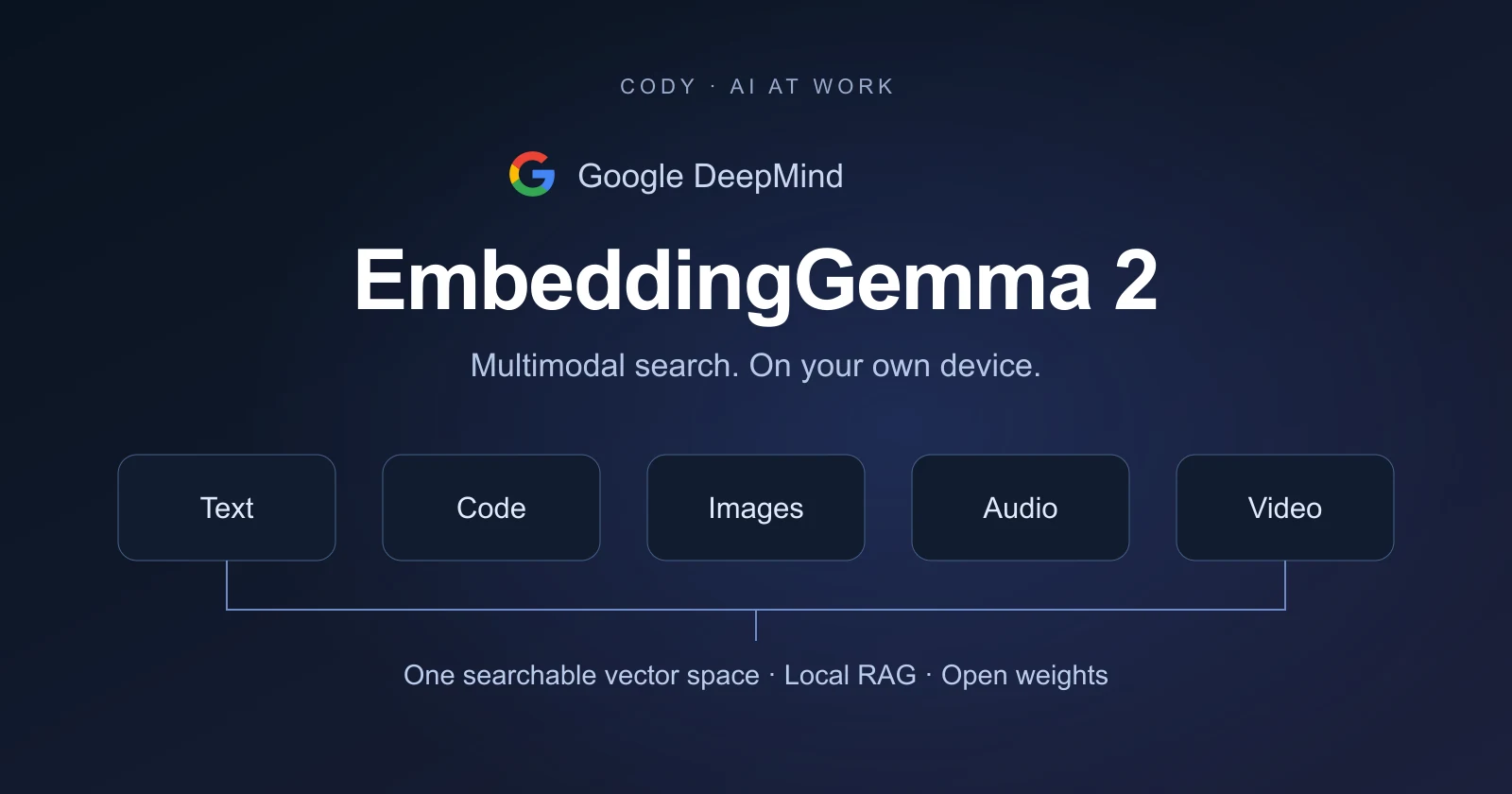
EmbeddingGemma 2 is Google's new open-weight model for that retrieval problem. Released on October 6, 2026, it represents text, code, images, audio, and video in a shared search space, with an emphasis on running on your own hardware. This is a search component, not another chatbot. Google's launch announcement sets out the local, multimodal direction.
Our take: the interesting part is not that every business should replace its current embeddings. It is that private media search and local AI assistants now have another practical building block. Whether it improves your system depends on what you need to retrieve, where it must run, and how much engineering you want to own.
For the specifications and comparison links, see our EmbeddingGemma 2 model profile. Here, we will explain what changed, where it fits in RAG, and how to assess it without getting lost in model terminology.
What is EmbeddingGemma 2, in plain English?
An embedding is a numerical representation of content. Search software compares those representations to find items that are meaningfully related, even when their wording differs. You do not read the vector; you use it to find the thing you actually want to read, watch, or hear.
EmbeddingGemma 2 extends that idea across media. A question typed in words can lead to an image or a recording, rather than only another passage of text. Its official Google checkpoint includes a text component and optional vision and audio encoders. You can load the parts your application needs rather than always running the full multimodal setup.
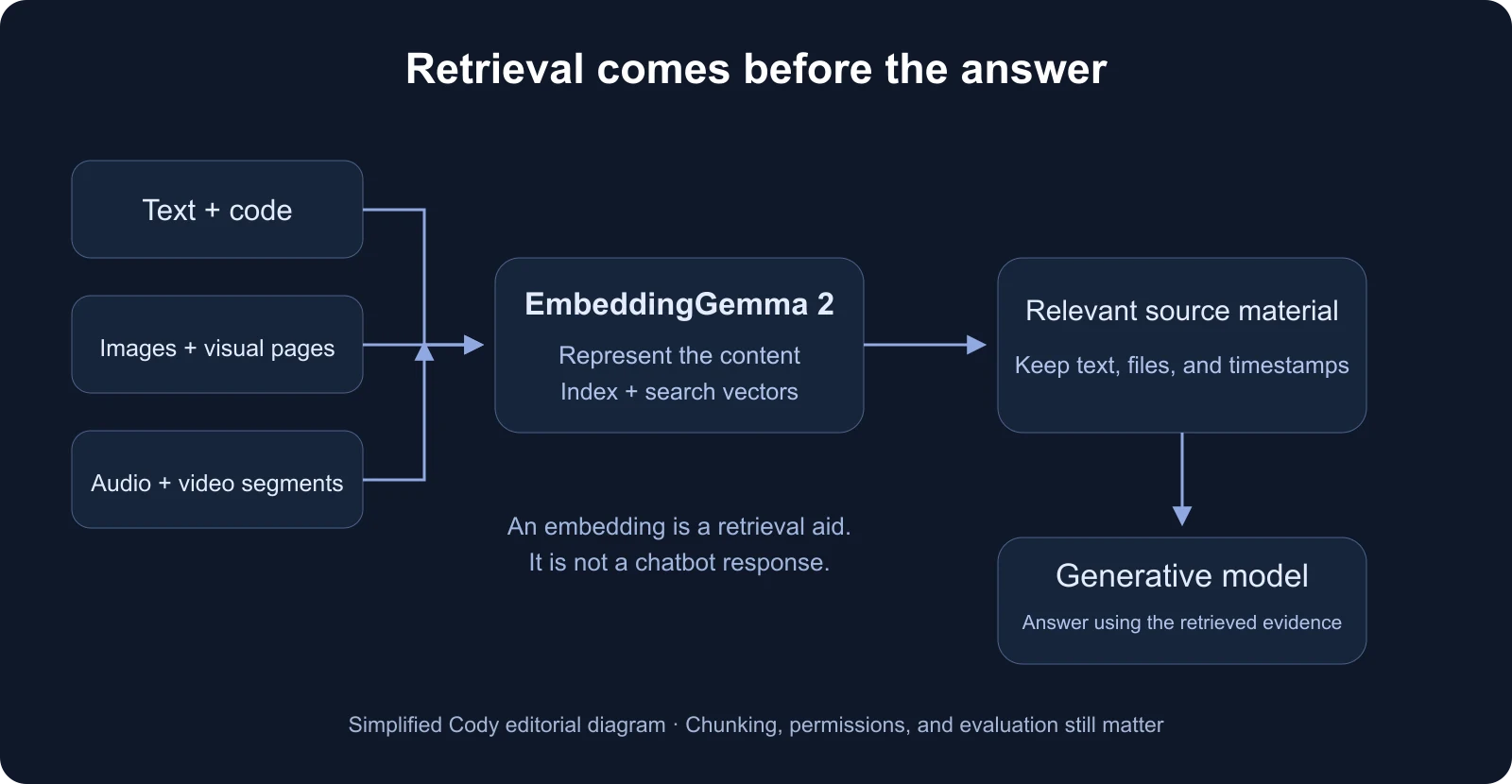
Think of it as the librarian, not the author. It helps identify useful source material. A separate generative model can then turn that material into an answer, and the application still has to handle access permissions, citations, and the original files.
That separation matters. A convincing chatbot answer can hide a weak search system. Improving retrieval gives the answering model better evidence; it does not automatically make every answer correct.
EmbeddingGemma 2 vs EmbeddingGemma 1: what changed?
The original EmbeddingGemma was already a compact, multilingual text embedding model designed for local use. Version 2 is not the beginning of Google's on-device search story. The main expansion is media support, alongside a stronger code-retrieval result. Google's version overview distinguishes the two generations.
| What matters | EmbeddingGemma 1 | EmbeddingGemma 2 |
|---|---|---|
| Main inputs | Text | Text, code, images, audio, and video |
| Architecture | Gemma 3-based | Gemma 4-based |
| Published size | 308M parameters | 270M for text/code; 740M with all encoders |
| Context budget | 2,048 tokens | 8,192 tokens shared across text and media |
| Vector sizes | 768, with smaller supported sizes | 768, 512, 256, or 128 dimensions |
| Weights license | Gemma terms | Apache 2.0 |
The version-2 specifications and license are documented in Google's model card. The smaller text-only configuration is worth noticing: adding media capability does not mean every application must carry the full model.
For an existing text knowledge base, this is a reason to evaluate—not an automatic migration order. If version 1 already finds the right passages reliably, new image and audio encoders may solve a problem you do not have. A team searching code, visual instructions, or recordings has a more obvious reason to try version 2.
Why it matters for RAG and private knowledge
Retrieval-augmented generation, or RAG, means finding relevant source material before asking an AI model to answer. The quality of that first step shapes everything that follows.
A familiar example is an internal support assistant. Written troubleshooting notes may explain a fault, but a technician might also need the annotated photo that shows the correct connector. A multimodal retrieval layer could help bring those pieces together. That is a hypothetical use case, not a claim that this model has passed a safety-critical support evaluation.
We would consider three kinds of pilot first:
- A private media library: finding useful screenshots, product photos, or visual instructions with ordinary language.
- A local developer assistant: retrieving relevant code without sending the entire repository to an embedding service.
- A searchable recording archive: returning a relevant segment and its timestamp, rather than making someone skim a whole recording.
In each case, retrieval should point back to evidence. Keep the file reference, document section, access scope, and media timestamp alongside the vector. A similar-looking result is not enough if the user cannot open it or understand why it was returned.
It also does not replace document preparation. Finding a visual page and extracting a spreadsheet-quality table are different jobs. If your problem is broken PDF reading order, missing headings, or unreliable table extraction, start with the ingestion layer. Our Docling guide and Cohere Parse explainer cover that side of the pipeline.
What Google's benchmarks actually show
The published results tell a more specific story than “better at everything.” In the full-precision, 768-dimensional evaluation in Google's model card, the multilingual MTEB score moves from 61.15 to 61.36. The code MTEB score moves from 68.76 to 78.68—about a 14% relative increase on that particular evaluation. These are Google-reported results, not our own tests. The benchmark tables name the evaluation versions and metrics.
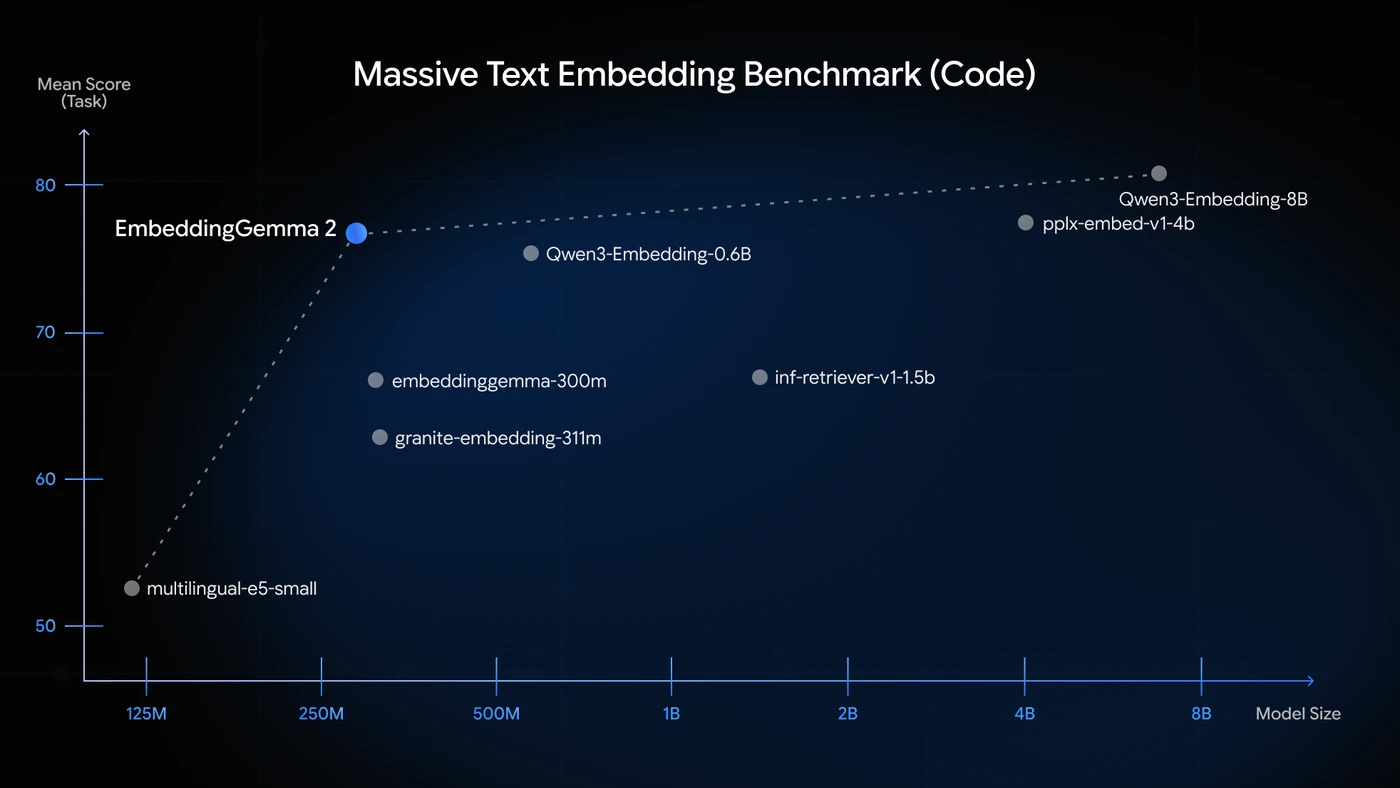
Our reading is that the headline is breadth plus better code retrieval, with roughly preserved multilingual text performance. That is more useful than treating a percentage from one benchmark as a promised improvement to every business search query.
The right follow-up question is: does it retrieve your relevant sources? A model can score well on public tasks and still struggle with your abbreviations, unusual diagrams, mixed-language files, or poor recordings. A small evaluation set of real questions and expected evidence is more actionable than a universal winner label.
Local does not mean free—or automatically private
Open weights change the cost structure. You are not buying a fixed token rate from Google's hosted embedding API for this release. You are responsible for compute, memory, indexing time, deployment, and maintenance. The Apache 2.0 release allows a different deployment path; it does not remove operating costs.
That can be attractive when content must stay near the user or work without a network connection. Google's AI Edge guide demonstrates local media search and video retrieval on consumer devices. Its memory and latency measurements are tied to specific devices, configurations, and workloads—not a guarantee for every laptop or phone.
For a pilot, we would measure the whole experience: how long the first index takes to build, how quickly queries return after indexing, peak memory during processing, battery impact, and what happens when files change. A fast query is not the same thing as a fast initial import.
Privacy is also an application property. Local embedding inference can keep the source material out of a remote embedding API. But cloud backups, telemetry, a remote vector database, or a hosted answering model may still move data elsewhere. Map the full data path before calling a system “fully local.”
Similarly, vectors are not an access-control system. Preserve source permissions and filter results for the person asking the question. A private file should not become discoverable just because its vector shares an index with public material.
Smaller vectors: useful savings with a real tradeoff
The model supports shortening its embeddings, a technique called Matryoshka Representation Learning. Google's developer guide explains the supported sizes and the need to normalize a vector again after truncation.
The practical idea is simple: storing fewer numbers per item can make a large index smaller. Reducing a vector from 768 to 128 dimensions cuts the raw vector payload sixfold when the number format stays the same. It does not make the entire application or database six times cheaper; original files, metadata, and search-index overhead still exist.
Nor is the smallest setting a free quality upgrade. Google's results show a more substantial multimodal drop at 128 dimensions than at 256 or 512. We would begin a media-search pilot at the native size, establish the retrieval baseline, and then test smaller vectors against the same questions. Queries and indexed items must use compatible dimensions.
This is a good optimization to make after proving usefulness. Saving storage on an index that returns the wrong recording is not much of a win.
EmbeddingGemma 2 vs Gemini Embedding 2, OpenAI, and Cohere
These are not interchangeable delivery models. The first decision is often whether you want to run embeddings yourself or consume a managed service. Public benchmarks do not establish a fair winner across every runtime, corpus, and modality.
Gemini Embedding 2: managed multimodal retrieval
Gemini Embedding 2 is Google's hosted multimodal embedding option. Its current API guide supports text, images, audio, video, and PDFs, with a default output of 3,072 dimensions and configurable smaller outputs. Google's Gemini embedding documentation is the reference for API behavior.
Our view: consider Gemini when managed infrastructure is the priority; consider EmbeddingGemma when local operation or control over deployment is central. The tradeoff is not simply “large vectors versus small vectors.” You are choosing where processing happens and who operates it. See the EmbeddingGemma 2 vs Gemini Embedding 2 comparison.
OpenAI text-embedding-3-large: a text-focused API
OpenAI text-embedding-3-large is a hosted text embedding model, not a native image, audio, or video embedding replacement. OpenAI documents a default 3,072-dimensional output and a way to request fewer dimensions. The standard API price currently listed is $0.13 per million input tokens; that is API usage, not a ChatGPT subscription. OpenAI's embedding guide and API pricing explain the scope.
For a well-prepared text corpus, a managed text service may remain the simpler choice. For native media retrieval or offline indexing, you are solving a different problem. Our OpenAI comparison page separates those capabilities from pricing.
Cohere Embed 4: another existing multimodal option
In Cohere's lineup, Embed 4 handles text, images, and mixed document content. That makes it a relevant comparison for enterprise retrieval, particularly when source documents contain both written and visual information. Cohere's current embedding documentation lists its model family and capabilities.
We would compare the actual document workload, deployment requirements, and procurement options, not assume all “multimodal” models process the same files in the same way. See EmbeddingGemma 2 vs Cohere Embed 4 for the published facts.
How to try it without turning this into a research project
Start with a question people already struggle to answer. Choose a bounded collection—one code repository, a folder of visual instructions, or a small set of recordings. Avoid indexing everything before you know what success looks like.
For a visual introduction, Google's AI Edge Gallery examples demonstrate Instant Media Search and Video Moments Finder. The same AI Edge announcement describes an experimental local meeting companion for Mac. It also describes ML Kit Android integration as forthcoming; do not assume an announced future integration is already available.
For developers, the Transformers documentation explains the model components and media processing. Video retrieval uses sampled frames, so a brief event between samples can be missed. Context is shared across the inputs in a request; longer recordings and document collections still need sensible segmentation.
Keep two implementation details on the checklist. First, follow the documented query and document task prompts rather than treating every input identically. Second, use the supported numerical precision: Google's checkpoint guidance recommends bfloat16 or float32 and warns against float16. These are details for the person building the pilot, not decisions an end user should have to make. The official checkpoint instructions cover both.
Then test more than the easy searches. Include near-matches that should not be returned, missing information, mixed-language questions, and files the user is not allowed to access. Check whether the right source appears in the first few results, and inspect the evidence rather than judging only the final answer.
If you are migrating from another model, our recommendation is to build a separate candidate index and re-embed the test corpus. Matching vector lengths do not establish compatibility between different models. Compare the two systems on the same source collection before replacing a working index.
The takeaway: a wider retrieval toolkit, not a universal replacement
EmbeddingGemma 2 is most interesting where useful knowledge is spread across media and where local processing has a clear purpose. It expands what an open-weight retrieval layer can search while allowing applications to load only the encoders they need.
Our recommendation is to treat it as a focused pilot: prove that it finds the right evidence, verify the data path, and measure the real device cost. If it solves those problems, the model size and vector settings become useful engineering choices. If it does not, a strong benchmark headline is not enough reason to switch.
Browse the embedding model library for alternatives, or use the EmbeddingGemma 2 profile for its sources, deployment notes, and focused comparisons. This is an educational review of Google's release, not an announcement that Cody provides EmbeddingGemma inference.
Frequently asked questions
Is EmbeddingGemma 2 a chatbot?
No. It produces embedding vectors that software uses for retrieval, similarity, classification, or clustering. A separate generative model is needed if the application should write an answer.
Is EmbeddingGemma 2 free?
Google releases the weights under Apache 2.0. That does not make compute, storage, or hosting free. There is no single fixed hosted API token rate in the release documentation.
What changed from EmbeddingGemma 1?
Version 2 adds native image, audio, and video retrieval alongside text and code, expands the context budget, and offers modular encoders. Google's evaluations show a stronger code result and nearly unchanged multilingual text performance.
Can EmbeddingGemma 2 run offline?
Local inference can support offline search once the required software, weights, and indexed content are on the device. The complete application is offline only if its other components do not require remote services.
Is EmbeddingGemma 2 better than Gemini Embedding 2?
There is no universal winner established here. EmbeddingGemma 2 provides open weights for local or self-hosted deployment, while Gemini Embedding 2 is a managed API. Compare retrieval quality, media support, cost, and deployment requirements on your own data.
Does it replace a document parser or a vector database?
No. It represents content for search. Parsing, chunking, source permissions, vector indexing, and answer generation remain separate responsibilities in a RAG system.