

- AI Knowledge Base
- AI tools
- Artificial Intelligence
Cohere Parse v5.0: Why Better RAG Starts With Better Documents
Cohere Parse v5.0 turns PDFs, slides, tables, forms, and images into RAG-ready Markdown. Here is what makes it different, where it fits, and what its limits mean for enterprise search.

Cohere's new document model tackles the part of RAG most demos skip: turning messy files into information an AI can actually retrieve
A RAG system can only retrieve the version of a document it was given. If a parser drops a table row, reads a two-column page in the wrong order, or separates a caption from its image, the mistake becomes part of the knowledge base. A better embedding model may retrieve that mistake more accurately. A more capable language model may explain it more fluently. Neither can reliably reconstruct information that disappeared during ingestion.
That is why Cohere's launch of Parse v5.0 on August 27, 2026, is more interesting than the phrase “document parser” might suggest. Parse is a vision-language model built to convert complex business files into structured Markdown before those files are chunked, embedded, searched, reranked, or handed to an AI agent.
In other words, Cohere is treating document preparation as a model problem of its own—not as a little OCR utility hidden at the edge of the stack.
What is Cohere Parse v5.0?
Cohere describes Parse as a compact vision-language model for high-volume enterprise document processing. It accepts PDFs, PowerPoint files, and JPEG images through the standalone Parse interface and returns Markdown designed for downstream AI applications.
It can extract more than running text:
- text in its intended reading order;
- tables, represented as HTML inside the Markdown output;
- lists, forms, and key-value pairs;
- images and generated descriptions or captions;
- page boundaries and locations for supported visual elements.
Cohere says the model is stable across Arabic, English, French, German, Italian, Japanese, Korean, Portuguese, and Spanish. It can attempt other languages without examples, although Cohere warns that quality may be lower.
The model itself is relatively small by current AI standards—2.3 billion parameters and roughly 4.6 GB, according to the official model documentation. That detail matters less as a benchmark of intelligence than as a clue to Cohere's strategy: specialize a compact model for parsing so it can run quickly, cheaply, and in private environments.
Why document parsing is a RAG problem, not just an OCR problem
Traditional OCR asks a narrow question: Which characters are visible on this page? Document understanding asks a harder one: How do those characters, boxes, lines, images, and positions relate to one another?
Consider a quarterly report with two columns, a footnote, and a table. Plain text extraction might read across both columns, place the footnote in the middle of a sentence, and flatten the table into a stream of numbers. Every character could be technically correct while the meaning is badly damaged.
A modern parser tries to preserve the reading order and structure. That gives a chunking system better boundaries, an embedding model more coherent passages, a retrieval engine more meaningful candidates, and a generator better evidence to cite.
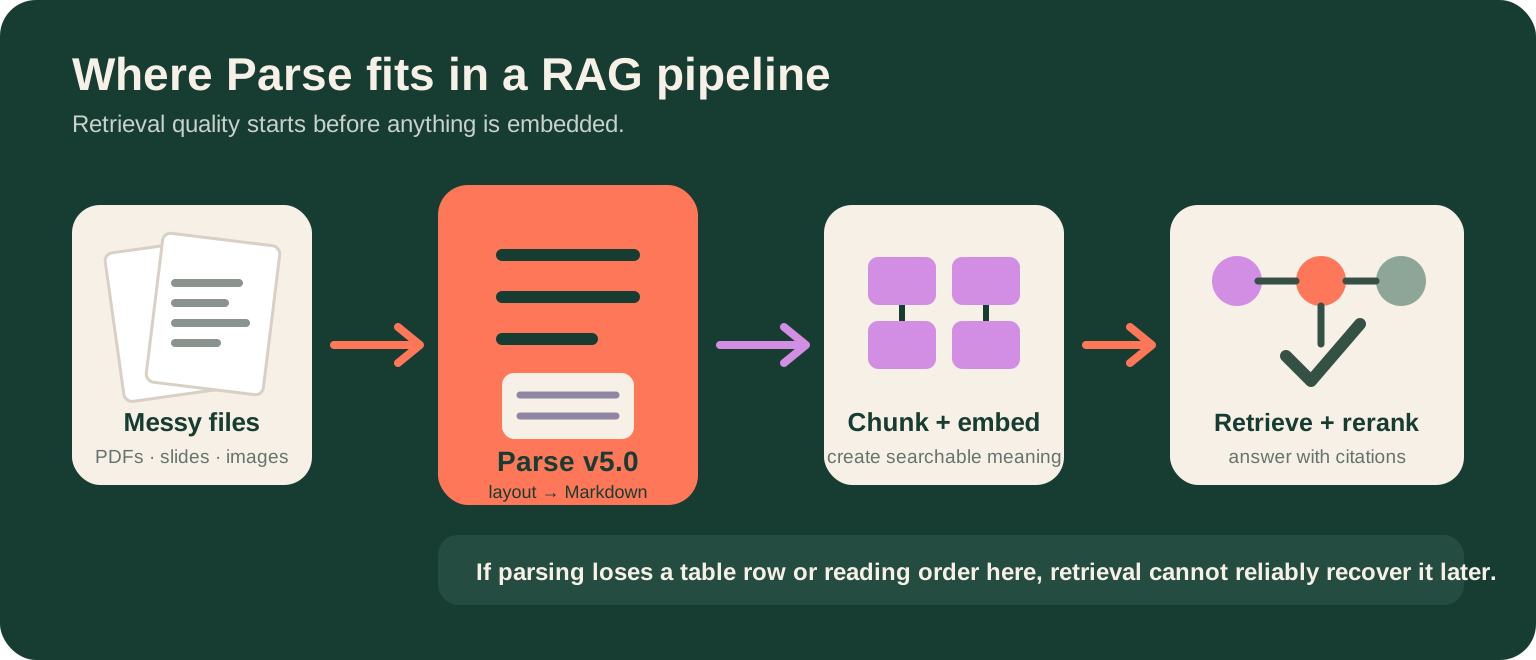
This is the key architectural point: parsing quality and retrieval quality are connected. If the source representation is wrong, the rest of the stack is solving the wrong problem.
What makes Cohere Parse different?
It is designed to see document structure
Parse uses visual information rather than treating a file as a bag of text. It is meant to recognize tables, forms, diagrams, embedded images, and spatial relationships. That is especially useful in business documents where meaning is carried by layout: an amount beside a label, a value beneath a column heading, or a note attached to one chart rather than another.
This “beyond OCR” language is not unique to Cohere—several document-intelligence systems now combine text recognition with layout and vision—but it places Parse in the newer generation of multimodal parsers rather than the older character-extraction category.
Its output is meant for downstream AI
Parse returns readable Markdown rather than a visual replica of the page. Tables are preserved as HTML, images receive descriptions, and supported elements include coordinates. That format is convenient for chunking, indexing, human inspection, and citation workflows.
There is a tradeoff in that choice. Markdown is flexible and easy to work with, but teams that require a rigid application schema will need another transformation and validation step. Parse does not currently return structured JSON.
It is aimed at enterprise volume and private deployment
The public API price is $1.50 per 1,000 pages. Cohere reports throughput of 4.5 pages per second on one H100 GPU and 36 pages per second on an eight-H100 node. These are Cohere's measurements, so buyers should test their own file mix, but they make the intended market clear: large ingestion jobs rather than occasional one-page uploads.
Parse is generally available through the Cohere API, Cohere's single-tenant Model Vault, Microsoft Foundry, and AWS SageMaker. Model Vault and private-cloud or on-premises options are particularly relevant when the source files contain regulated or proprietary information.
How Parse fits into Cohere's RAG stack
Cohere has built a recognizable set of retrieval components. Parse prepares the file. Embed represents its content for semantic search. Rerank looks at an initial set of candidates and moves the most relevant ones to the top. A generation model can then answer from that evidence.
| Layer | Cohere component | Job |
|---|---|---|
| Ingest | Parse | Turn visual documents into structured content |
| Represent | Embed | Convert chunks into searchable vectors |
| Retrieve | Search + Rerank | Find candidates, then improve their ordering |
| Answer or act | Command or another model | Use the retrieved evidence in a response or workflow |
Teams can use Parse as a standalone component or as part of Cohere Compass. Compass adds managed ingestion, chunking, embedding, indexing, hybrid search, two-stage retrieval, connectors, and access controls. It also accepts a broader set of source formats, including Word, Excel, and HTML, by routing them through appropriate text or vision paths.
That choice is strategic. A team can keep its existing vector database and retrieval layer while replacing only the parser, or adopt more of Cohere's managed document-to-answer pipeline. Parse makes Cohere more credible at both ends of that spectrum.
Parse v5.0 benchmarks: what Cohere is claiming
Cohere reports an average score of 79.2 on three dimensions of ParseBench: table extraction, content faithfulness, and semantic formatting. In the same evaluation, Cohere reports 78.3 for LlamaParse's Cost Effective tier, 77.7 for Chandra OCR 2, 74.5 for Mistral OCR 4, and 72.4 for Databricks AI Parse.
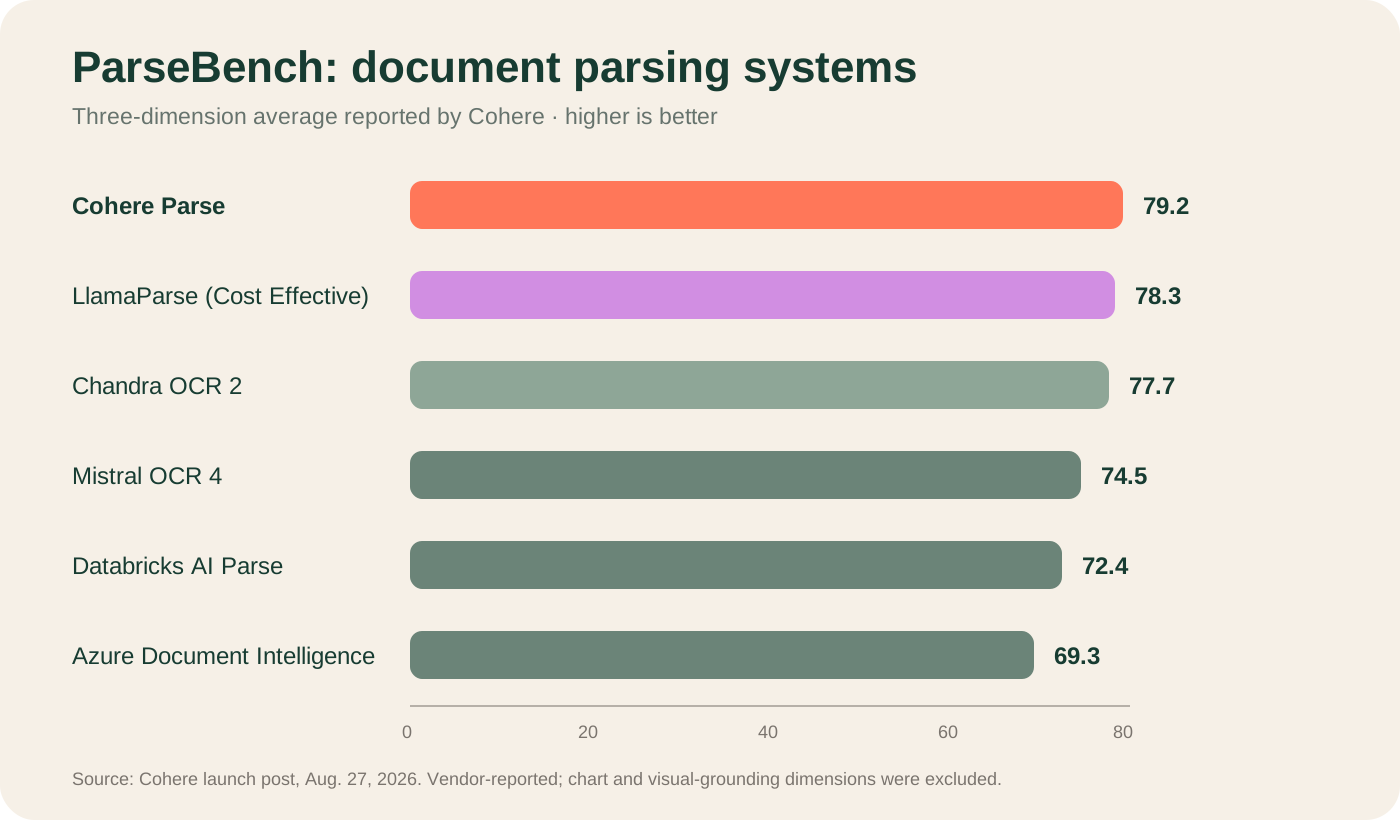
The detailed scores are revealing. Cohere reports 87.0 for tables and 86.6 for content faithfulness, but 64.0 for semantic formatting. Parse looks strongest where RAG teams often feel pain first—capturing the table correctly and not losing or inventing content—while formatting remains a harder area.
Two caveats are important. First, Cohere excluded ParseBench's chart and visual-grounding dimensions from its headline average because they fall outside the current product scope. Second, frontier general-purpose models scored higher in Cohere's test, but they are much larger and priced for a different job. Cohere's argument is primarily about price-performance at scale, not winning every raw accuracy comparison.
Where Parse looks most useful
- Document-heavy RAG: knowledge bases built from reports, manuals, presentations, contracts, and scanned business material.
- Tables and forms: invoices, claims, financial statements, applications, and other files where rows and labels carry the meaning.
- Multilingual collections: organizations working across the nine languages Cohere lists as stable.
- High-volume ingestion: archives measured in hundreds of thousands or millions of pages, where per-page cost and throughput compound.
- Regulated data: deployments that need single-tenant, private-cloud, or on-premises inference.
- Agentic workflows: agents that need reliable document context before they can make a decision or take an action.
It may be less compelling for clean, born-digital text that an existing extractor already handles perfectly. A specialized vision parser adds the most value when layout and visual content are actually part of the information.
Known limitations matter as much as the headline
Cohere is unusually clear about what the first Parse release does not do. According to its documentation:
- it does not return confidence scores for extracted content;
- it does not identify headers, footers, or font hierarchy as explicit document elements;
- it returns Markdown rather than structured JSON;
- the standalone model supports PDF, PowerPoint, and JPEG—not every common office format;
- it describes charts as visual elements but does not currently extract chart data series into tables.
The chart limitation is especially important. A RAG system might retrieve a useful description of a graph, but an analytics workflow should not assume it has received the underlying values. Cohere says chart-data extraction is planned for a future parser version.
The absence of confidence scores also changes error handling. Teams cannot simply route every low-confidence page to human review. They will need their own validation rules—checking totals, required fields, table shape, retrieval answers, or comparisons against a golden set.
How to evaluate Parse before adding it to a RAG pipeline
- Build a difficult document set. Include multi-column PDFs, scans, rotated pages, dense tables, forms, footnotes, charts, and each language you expect to support.
- Define structural ground truth. Do not score only character accuracy. Check reading order, table cells, labels, page boundaries, image placement, and whether meaningful formatting survives.
- Test retrieval questions end to end. Parse and index the documents, then ask questions whose answers depend on layout. Measure whether the correct passage is retrieved before judging the final response.
- Inspect citations. A plausible answer is not enough. Confirm that the cited chunk contains the right source evidence and still points to a useful page or region.
- Measure the real workload. Record pages per second, cost per thousand pages, retries, unusually large outputs, and failure rates across clean and messy files.
- Design a fallback path. Decide what happens when a page is unsupported, blank, malformed, or fails a business validation rule.
- Compare against the current pipeline. The right question is not whether Parse beats a benchmark. It is whether it improves retrieval accuracy and lowers total operating cost on your documents.
For more background on the rest of the architecture, see our guide to RAG APIs and retrieval-augmented generation, our overview of vector databases, and the difference between semantic search and fine-tuning.
Is Cohere Parse better than traditional OCR?
For complex layouts, tables, forms, and mixed visual content, a vision-language parser can preserve meaning that basic OCR misses. That does not make traditional OCR obsolete.
A mature OCR system may still be faster, cheaper, easier to audit, or more predictable for clean scans and fixed templates. Some document-intelligence services also offer confidence scores and typed JSON fields that Parse lacks. The choice should depend on the files and the downstream task, not the modernity of the label.
A useful split is simple: if the problem is mainly recognizing characters, conventional OCR may be enough. If the problem is understanding how the page is organized so an AI can search or reason over it, Parse belongs in the evaluation.
What this release means for enterprise RAG
For years, most attention in RAG went to vector databases, embedding models, rerankers, and generators. Parsing was treated as plumbing. Cohere's launch reflects a more mature view: ingestion deserves its own model, evaluation set, cost model, and deployment decision.
That is good news even for teams that never choose Cohere Parse. It pushes the industry to ask better questions. What information is lost before indexing? Which layouts break retrieval? Can a citation be traced back to the right page? What happens when a table is flattened incorrectly? Those questions are closer to real RAG quality than another comparison of chatbot prose.
Parse also strengthens Cohere's position as an end-to-end retrieval company. The company can now offer a path from an unopened PDF to a grounded answer, while still letting teams adopt one component at a time.
Frequently asked questions
What is Cohere Parser 5.0?
“Cohere Parser 5.0” is a common shorthand for Cohere Parse v5.0, a vision-language model that converts enterprise documents and images into structured Markdown for search, RAG, document processing, and AI agents.
Which file formats does Cohere Parse support?
The standalone Parse documentation lists PDF, PowerPoint, and JPEG. Cohere Compass supports additional formats, including Word, Excel, and HTML, through its managed ingestion pipeline.
Which languages does Parse v5.0 support?
Cohere lists nine stable languages: Arabic, English, French, German, Italian, Japanese, Korean, Portuguese, and Spanish. Other languages may work zero-shot with lower accuracy.
Does Cohere Parse return JSON?
No. Parse currently returns Markdown, with tables represented as HTML. Teams that need a strict JSON schema must add a separate extraction and validation step.
Can Parse extract data from charts?
Not as structured data series in the current release. It can treat charts as visual elements and provide descriptive metadata, but Cohere says numerical chart extraction is planned for a future version.
How much does Cohere Parse cost?
Cohere lists the public API at $1.50 per 1,000 pages. Private Model Vault economics depend on deployment and utilization, so high-volume teams should compare total cost with their own throughput.
The bottom line
Cohere Parse v5.0 is not a new chatbot and not a complete RAG system. It is the model that tries to make the document usable before retrieval begins.
That may sound like a narrow job, but it sits at the point where many RAG failures are created. Parse brings visual understanding, table and form extraction, multilingual support, predictable per-page pricing, and private deployment to that first stage. Its limitations—Markdown-only output, no confidence scores, limited standalone formats, and no numerical chart extraction—are real and should shape any evaluation.
The larger lesson is straightforward: better answers do not begin with a bigger language model. They begin with a faithful representation of the source. For organizations building AI on private knowledge, parsing is no longer the boring step. It is part of the intelligence layer.