

- AI tools
- Artificial Intelligence
What Happened to Gemini 3.5 Pro? Gemini 4 Argon, Delays, and Google’s AI Race
Google missed its Gemini 3.5 Pro window and unveiled Gemini 4 Argon to limited testers. Here is what was delayed, what Argon can do, and whether Google is actually falling behind.
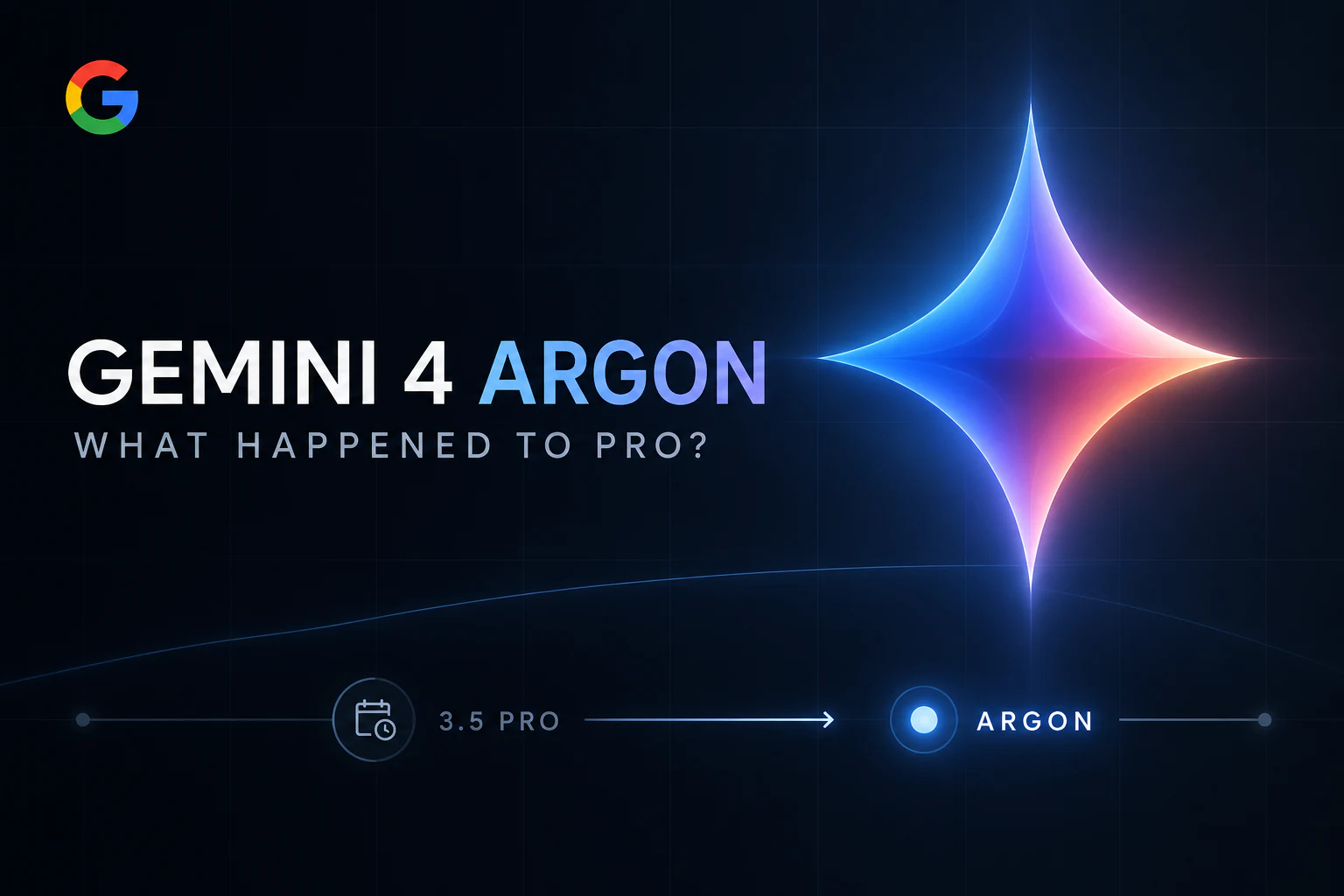
Google did miss the Gemini 3.5 Pro date it announced. Gemini 4 Argon is real—but announcing a model and making it broadly available are not the same thing.
If you have been waiting for a new Gemini Pro model, the last few months have been confusing. Google said Gemini 3.5 Pro would arrive in June 2026. June passed. Google kept releasing faster and cheaper Flash models, while OpenAI and Anthropic shipped new frontier systems. Then, on September 30, Google jumped ahead a generation and announced Gemini 4 Argon.
That sounds like the wait is over. It is not—at least not for most people. Argon is initially rolling out to a small group of trusted cybersecurity partners, and Google has not given a firm date for its wider API, enterprise, or consumer release.
So is Google falling behind? The fairest answer is: Google fell behind on flagship release timing and public availability, but the early evidence does not show that it has fallen out of the frontier-model race. Argon's reported performance looks competitive. The problem is that developers and subscribers cannot broadly verify that performance yet.
This article separates what Google has confirmed, what credible reporting says, and what remains speculation. Cody does not sell access to Gemini 4 Argon; this is independent editorial coverage for people following the fast-moving AI model market.
Quick answer — updated October 2, 2026
Gemini 3.5 Pro missed the June launch window Google announced at I/O. Google has now announced Gemini 4 Argon, a new flagship model for coding, professional work, and cyber defense, but access is limited to trusted cyber partners. Google says broader access will begin with paid API customers and Google AI Ultra subscribers, without giving a date. Google has not confirmed that Argon is simply 3.5 Pro under a new name.
What happened to Gemini 3.5 Pro?
At Google I/O on May 19, CEO Sundar Pichai said Gemini 3.5 Pro was being used internally and would arrive “next month”. That placed the expected release in June 2026.
Google did release Gemini 3.5 Flash and continued updating its lower-cost model line. But the promised Pro model did not appear in June. In July, Bloomberg reported, based on conversations with current and former employees, that 3.5 Pro was months behind schedule while Google worked to improve its capabilities, especially coding. The report also described frustration inside the organization and a slower approval process created by the many teams involved in deploying Gemini across Google products.
Google did not publicly cancel 3.5 Pro. It also did not announce that the model had been renamed. Instead, the company spent the summer shipping Flash, Live, and specialized models before unveiling a new flagship name: Gemini 4 Argon.
Gemini Pro and Argon: the timeline
| Date | What happened | Why it matters |
|---|---|---|
| February 19, 2026 | Google released Gemini 3.1 Pro. | This remained Google's broadly available high-end Pro model while competitors advanced. |
| May 19, 2026 | Google launched Gemini 3.5 Flash and said 3.5 Pro would come the following month. | Google created a clear June expectation in its own keynote. |
| June 2026 | The announced window passed without a 3.5 Pro launch. | This is the confirmed delay—not merely a rumor. |
| July 16, 2026 | Bloomberg reported that the model was months behind and needed more coding work. | The reason is credible reporting from unnamed sources, not an explanation Google formally published. |
| July–September 2026 | Google continued releasing Flash, Live, audio, and specialized Gemini models. | The whole Gemini program was not frozen; the gap was concentrated at the flagship Pro tier. |
| September 30, 2026 | Google announced Gemini 4 Argon to trusted cyber defenders through its Fairwind Program. | Google returned with a new flagship, but not a normal public launch. |
| October 2, 2026 | No firm broad-release date or public API model ID has been announced. | Argon's availability remains the central question. |
Is Gemini 4 Argon the delayed Gemini 3.5 Pro?
Google has not said so. It is reasonable to infer that research, training runs, evaluation work, and product lessons from the delayed Pro effort contributed to Argon. It is not reasonable to present “3.5 Pro was renamed Argon” as a confirmed fact.
The naming suggests a more substantial reset. Argon is part of the Gemini 4 generation, and a Google spokesperson told Reuters that it is larger than the company's previous high-end Pro line. Google's announcement also emphasizes unusually long outputs, defensive cybersecurity, and sustained work across long, multi-step professional tasks.
The safest interpretation is that 3.5 Pro missed its public window and Argon became Google's next announced flagship. Whether Google discarded one checkpoint, continued training it into another, or changed the release plan for product reasons has not been publicly documented.
What is Gemini 4 Argon?
Gemini 4 Argon is Google's new frontier model for long-running, complex work. Google positions it across four main areas:
- Software engineering: debugging, large migrations, optimization, and agentic coding.
- Professional knowledge work: financial research, legal drafting, tax, and business automation.
- Cybersecurity defense: finding, validating, and patching vulnerabilities.
- Long-horizon reasoning: sustaining a plan across much longer trajectories instead of answering one short prompt.
Google says Argon's maximum output has increased from 64,000 to 1 million tokens. That is an output claim, not permission to treat every million-token response as useful. Very long generations can increase latency, cost, review burden, and the chance that errors compound. The practical value will depend on whether the model can stay coherent and check its work across those long runs.
Google also describes internal examples: Argon agents reportedly identified data-center memory optimizations that freed more than 300 TiB after rollout, and worked on C or C++ to Rust migrations ranging up to more than 800,000 lines for the Fuchsia Zircon kernel. These examples are interesting, but they are Google-reported internal results, not independently reproducible case studies.
Is Gemini 4 Argon available now?
Only to a narrow initial group. Google says Argon is rolling out through its Fairwind Program to trusted cyber defenders. The company is also participating in the U.S. government's voluntary process for pre-release access and says it is using early feedback to strengthen safeguards.
Google says wider availability will start with:
- paid Gemini API customers; and
- Google AI Ultra subscribers.
It has not announced the exact date, regional coverage, rate limits, an API model identifier, standard Google AI Pro access, or general availability. If Argon is missing from your Gemini app or Google AI Studio account, that is expected.
Gemini 4 Argon pricing
Google has announced pricing even though the model is not broadly available. The introductory rates are:
- $2 per million input tokens
- $10 per million output tokens
- $0.10 per million cached input tokens, reflecting a 95 percent cache discount
Google's footnote says the introductory period ends December 31, 2026. After that, the listed rates rise to $4 input and $20 output per million tokens. Those prices would still compare favorably with several frontier systems, but a token price is not the same as a task price. A model that reasons for longer, produces far more tokens, or needs more retries can cost more than the rate card suggests.
What Argon's benchmarks actually tell us
Google's launch material reports strong results across coding, business work, video understanding, and cyber defense. Highlights include 77.9 percent on DeepSWE v1.1, a number-one score of 51.3 percent on AutomationBench, and a tie for first at 68 percent on CWE-bench v1.
Those numbers support the claim that Argon belongs in the frontier conversation. They do not establish that it is the best model for every job. Benchmarks use different harnesses, effort settings, tool access, scoring rules, and prompt sets. Google also chose which results to feature.
An independent snapshot is more useful. Artificial Analysis currently scores Argon at 53 on its Intelligence Index. That places it in the leading group and around GPT-6 Astra's strongest configurations, while Claude Opus 5.5 scores higher in the current comparison. The same page still lists Argon's public output speed as unknown.
The sensible conclusion is not “Google won” or “Google failed.” It is that Argon's evaluated capability looks competitive, while availability, latency, reliability, and real production behavior are not yet broadly testable.
Gemini 4 Argon vs GPT-6 Astra, Claude, and Gemini Flash
| Model | Availability on October 2 | Standard or announced API rate | Practical read |
|---|---|---|---|
| Gemini 4 Argon | Trusted cyber partners; broader rollout promised | $2 input / $10 output introductory; later $4 / $20 | Very competitive early results and pricing, but most users cannot test it. |
| GPT-6 Astra | Rolling out across ChatGPT plans, API, Azure, and Bedrock | $10 input / $50 output | More expensive, but available enough for teams to run real evaluations. |
| Claude Opus 5.5 | Available through Claude and supported API or cloud channels | $4 input / $20 output | Strong current independent results with an established developer path. |
| Claude Fable 5.1 | Generally available across Anthropic and major clouds | $10 input / $50 output | A premium option for difficult coding and knowledge work. |
| Gemini 3.8 Flash | Generally available | $0.75 input / $3.75 output introductory | Google's practical choice today when speed, volume, and cost matter. |
The comparison exposes Google's immediate problem. Argon can look excellent on a chart, but OpenAI and Anthropic have already put their September frontier releases into customers' hands. For a production team, a model that can be tested today has an advantage over a model with a better promised price next week or next month.
So, is Google falling behind in AI?
It depends on what “behind” means.
On flagship release execution: yes
Google set its own June expectation for 3.5 Pro and missed it. The company did not provide a clear public reset, and the successor announcement still lacks a broad-release date. That hurts confidence among developers deciding where to invest.
On public access: temporarily, yes
Argon's closest rivals are available to more customers. Until ordinary developers can call Argon through the API, reported capability cannot erase the deployment gap.
On raw model capability: not clearly
Google's results and the first independent evaluation place Argon in the frontier group. The available evidence does not support the claim that Google can no longer build leading models. It supports a narrower claim: Google took longer to turn its next flagship into a broadly usable product.
On efficient models and product distribution: no
While Pro slipped, Google kept shipping Flash and Live models, including Gemini 3.8 Flash. It also controls Search, Android, Workspace, Google Cloud, and the Gemini app. That distribution gives Google ways to reach users that a benchmark leaderboard does not measure.
The strongest criticism is therefore not that “Google is finished.” It is that Google's frontier research, product naming, and public rollout have moved at different speeds. Argon may close the capability gap, but only a credible release can close the trust and availability gap.
Why would Google delay a model that benchmarks well?
There are three evidence-backed explanations, and they can all be true at once.
- The model needed more work. Bloomberg's July reporting pointed to coding performance and disappointing attempts to improve it. Its September reporting described skepticism from some internal users; Google disputed that characterization.
- Google has a larger deployment surface. A Gemini release can affect Search, Workspace, Android, Cloud, the consumer app, and external APIs. More integration and review points can slow a launch.
- Argon raises real safety questions. Google trained it for advanced cyber defense and is emphasizing prompt-injection resistance, misuse monitoring, sandboxing, and pre-release government review. A staged rollout is more defensible for a cyber-capable model than for a routine chatbot update.
Safety may explain the limited Argon release. It does not retroactively erase the missed 3.5 Pro commitment. Both facts belong in the story.
What developers and businesses should do now
Do not plan a production system around an unannounced Argon date. Wait for an official API identifier, account eligibility, rate limits, data terms, regional availability, and measured latency.
If you need a Google model now, evaluate Gemini 3.8 Flash on the real workload rather than waiting indefinitely for a Pro label. If the job requires the strongest available coding or professional reasoning, compare it with GPT-6 Astra, Claude Opus 5.5, and Claude Fable 5.1.
Use a small evaluation set built from your own tasks. Track accuracy, accepted-output rate, latency, retries, tool-use success, and total cost. A composite benchmark can identify models worth testing; it cannot choose one for your documents, codebase, policies, or customers.
When Argon becomes available, test it as a new candidate—not as an automatic winner. You can follow the expanding catalog in Cody's AI model library.
What is confirmed, reported, and still speculation?
| Claim | Status | Best reading |
|---|---|---|
| Gemini 3.5 Pro was expected in June 2026. | Confirmed | Google said “next month” at its May 19 keynote. |
| The June window was missed. | Confirmed | No public 3.5 Pro launch occurred in June. |
| Coding quality contributed to the delay. | Credible reporting | Bloomberg attributed this to current and former employees; Google did not publish it as the official explanation. |
| Argon is Gemini 3.5 Pro renamed. | Unconfirmed | Possible continuity is not proof of a simple rename. |
| Google canceled Gemini 3.5 Pro. | Unconfirmed | Google has not announced a cancellation, even though Argon now occupies the flagship conversation. |
| Argon will be broadly available soon. | Confirmed direction, unknown date | Google named the first target groups but gave no calendar date. |
| Google is permanently behind. | Opinion, not fact | Release execution lagged; capability evidence remains competitive. |
Frequently asked questions
Was Gemini 3.5 Pro delayed?
Yes. Google said on May 19, 2026 that Gemini 3.5 Pro would arrive the following month. June passed without a public release.
Was Gemini 3.5 Pro canceled?
Google has not announced a cancellation. Gemini 4 Argon has taken over the flagship conversation, but the company has not explained whether 3.5 Pro was shelved, absorbed into later work, or remains a separate internal model.
Is Gemini 4 Argon just Gemini 3.5 Pro renamed?
There is no confirmation of a simple rename. It is fair to say Argon followed the delayed Pro effort; it is speculation to say they are exactly the same model.
When will Gemini 4 Argon be released?
Google has not provided a date. It says access will expand after early safety testing, beginning with paid API customers and Google AI Ultra subscribers.
Can Google AI Pro subscribers use Argon?
Not broadly as of October 2, 2026. Google's announcement specifically names Google AI Ultra among the first wider groups and does not give a timing commitment for the lower-priced Pro plan.
How much will Gemini 4 Argon cost?
Google lists introductory API pricing of $2 per million input tokens and $10 per million output tokens, with cached input at $0.10. It says pricing will rise to $4 input and $20 output after December 31, 2026.
Is Gemini 4 Argon better than GPT-6 Astra or Claude Opus 5.5?
There is no universal winner. Argon is competitive on the current independent index and leads some published task benchmarks, while Astra and Opus lead other tasks and are more broadly available. Production tests are still missing for most Argon users.
Is Google falling behind OpenAI and Anthropic?
Google has fallen behind on flagship launch timing and immediate public availability. Current benchmark evidence does not show a decisive capability collapse, and Google's Flash models and product distribution remain major strengths.
Sources and methodology
This article was checked against Google's I/O 2026 keynote, the official Gemini 4 Argon announcement, and the current Google DeepMind model catalog. Delay and internal-performance context comes from Bloomberg's July report, Axios's launch coverage, and Reuters reporting. Independent benchmark context uses Artificial Analysis. Competitor availability and prices were checked against official OpenAI and Anthropic announcements. All sources were reviewed October 2, 2026. Company benchmarks and internal case studies are labeled as provider-reported; reported claims are not presented as Google-confirmed facts.
The bottom line
The Gemini story is not “Google stopped shipping.” Google shipped plenty of AI products in 2026. The real issue is that its promised flagship Pro model slipped while rivals made their newest high-end systems available.
Gemini 4 Argon is Google's answer, and the first evidence says it may be a serious one. Its combination of long-horizon reasoning, cyber capabilities, a million-token output limit, and aggressive pricing could make it highly attractive. But the most important benchmark right now is access. Until developers can use Argon at scale, Google has announced a comeback—not completed one.