

- Real-Time AI
- AI tools
Real-Time AI Avatar Models Compared: Latency, Architecture, and Cost
Architecture, latency definitions, transport, pricing, and a repeatable way to evaluate them yourself Every real-time avatar vendor publishes a latency number. Anam says sub-1-second conversation with ~150 ms server-side generation. Tavus says sub-600… Read more »

Architecture, latency definitions, transport, pricing, and a repeatable way to evaluate them yourself
Every real-time avatar vendor publishes a latency number. Anam says sub-1-second conversation with ~150 ms server-side generation. Tavus says sub-600 ms. Beyond Presence says under 100 ms. Simli says under 300 ms. LemonSlice says 471 ms. Ojin says under 200 ms.
None of these numbers are lies. Almost none of them measure the same thing.
That is the central problem with choosing a real-time avatar provider in 2026, and it is why teams routinely pick one on a spec sheet, integrate it, and then discover the experience feels slower than the number promised. This article is an attempt to fix that: what these systems actually are, how the models differ architecturally, what each published latency figure is really measuring, what they cost once you look past the headline rate, and — most usefully — a test protocol you can run yourself in an afternoon.
Two Products Wearing the Same Name
Before comparing anything, separate the category in two. Nearly every provider sells one or both of the following, and they are not substitutes.
The Agent API. The provider owns the whole stack: speech recognition, the language model, text-to-speech, the rendering, the transport, and usually a dashboard with a prompt field and a knowledge base. You configure a persona and drop a widget on a page. Fast to ship, minimal control, and your conversation quality is capped by the vendor's choice of models.
The Audio-to-Video API. The provider's scope stops at one job: take agent audio, return a lip-synced video stream in real time. You bring your own speech-to-text, your own LLM, your own voice, and your own orchestration — typically Pipecat or LiveKit Agents. This is the "face layer" model, and it is what most teams building a serious product end up using, because the avatar becomes an optional interface layer on top of a voice agent that already works.
The distinction matters commercially too. Beyond Presence charges exactly double for Agent mode versus its Speech-to-Video mode. HeyGen's Lite mode (you bring the brain) is roughly half the price of its Full mode.
A useful rule: build the voice agent first and get it good, then add the face. Teams that start with the avatar tend to end up with a beautiful system that says unhelpful things.
How These Models Actually Work
Three fundamentally different rendering approaches are in production right now, and the differences show up in ways that matter.
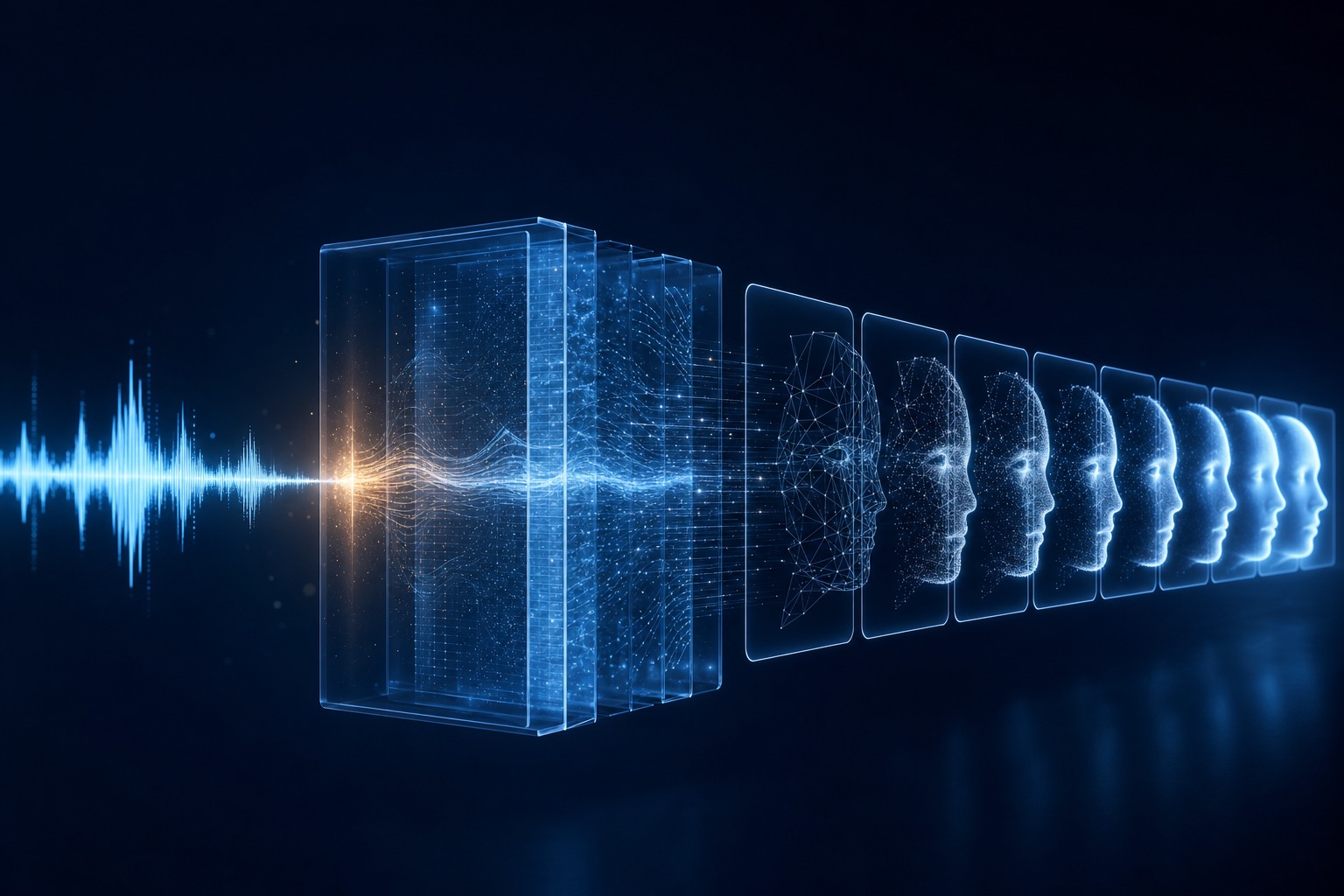
Every real-time avatar is the same shape underneath: driving audio in, generated frames out, fast enough to stay in sync. Image generated with GPT Image 2.
Pixel-space diffusion
The dominant approach. A diffusion model generates video frames directly, conditioned on the driving audio and a reference identity. Tavus describes Phoenix-4 as a Gaussian-diffusion model; LemonSlice uses a diffusion transformer. Because the model generates pixels rather than driving a rig, it can produce expressions, micro-movements and hand gestures that no rigged model was authored to have. It is also the most compute-hungry approach, which is why per-minute pricing in this category is what it is.
Gaussian splatting and learned representations
Simli renders from a Gaussian-splatting representation rather than full pixel-space generation. The tradeoff is visible in both directions: Simli's per-minute cost is roughly an order of magnitude below the pixel-diffusion providers, and independent reviewers have consistently flagged its idle behaviour — circular eye movement, mechanical head rotation, poor transitions between listening and speaking.
3D rendering
Uneeq builds volumetric digital humans in Unreal Engine and delivers them over WebRTC with pixel streaming. NVIDIA's ACE stack takes a related path: its Audio2Face-3D microservice converts speech into ARKit blendshapes that drive a 3D character, and ships as a self-hostable NIM container under an NVIDIA AI Enterprise licence. You will not mistake either for a photograph. In exchange you get full art direction, deterministic behaviour, stylised non-human characters, and — with the NVIDIA route — the only genuinely self-hosted option at the high end.
Avatar creation: photo versus video
This has quietly become the biggest practical differentiator. Two years ago every provider required a two-minute studio recording. Now Anam's Cara-4, Simli, LemonSlice, Hedra, Ojin and bitHuman can all generate an avatar from a single photograph, with no training step. Tavus and HeyGen still build their highest-quality custom avatars from a recorded video, which takes days rather than seconds but captures multi-angle facial data that single-image models have to infer.
The tradeoff is real. Single-photo generation lets you spin up a hundred personas in an afternoon. Video-trained replicas still tend to hold up better under scrutiny, because the model has seen the person's actual head turn.
The Six Different Things Called "Latency"
Here is the table that should exist on every vendor's pricing page and does not.
| What is measured | From → to | Typical published range | Does the user feel it? |
|---|---|---|---|
| Server-side generation | Audio chunk arrives → video frame produced | 100–250 ms | Only as part of the total. Smallest component. |
| Streaming inference latency | Inside the render loop only | Under 100 ms | No. Excludes network entirely. |
| Inference TTFB | Request → first byte of output | ~470 ms claimed | Partially. Excludes the LLM and TTS ahead of it. |
| Global avatar latency | Includes network egress to the client | ~250 ms | Closer. Still excludes the reasoning stack. |
| End-to-end conversation latency | User stops speaking → avatar starts speaking | 600 ms – 1.5 s | Yes. This is the one that matters. |
| Floor-prediction / turn-taking | How fast the system decides you finished | 55–300 ms | Yes, and it is often the largest recoverable chunk. |
A vendor quoting 100 ms and a vendor quoting 1 second may be describing the same system. The first is measuring its render loop; the second is measuring a whole conversational turn. When you compare providers, insist on the fifth row, measured from recorded audio and video on a single clock — and ask for p95, not just median.
There is one more number nobody publishes and everybody should: time to first frame on session join. In a kiosk or booth setting, the gap between someone walking up and the face appearing is the most consequential latency in the entire system, and independent reviewers have noted that several providers are slow to join even when their in-conversation latency is good.
Which latency actually predicts satisfaction
The only third-party blind evaluation of this category published so far ran 178 participants and found that responsiveness was the strongest single predictor of overall experience — a Spearman correlation of 0.697 — ahead of visual quality, which came second. That result is worth internalising before you spend a week comparing skin texture. Users do not reliably notice which model renders better. They notice, instantly, which one answers faster.
The Providers
Figures below are as published by each vendor or reported by third-party reviewers as of August 2026. Real-time avatar pricing has moved fast and will keep moving; treat every number as a starting point for your own measurement, not a specification.
Anam
Anam is a London spin-out founded in 2023 by former Synthesia staff. Its Cara-4 model, released in July 2026, generates a conversational avatar from a single photo at 25 fps, outputting 1152×768 in landscape and 768×1152 in portrait. Anam publishes sub-1-second median conversation latency with roughly 150–180 ms of server-side generation, supports 70+ languages, brings your own LLM, and lists SOC 2 Type II, HIPAA and GDPR coverage with zero data retention. Transport is WebRTC over Pion. It ranked first across visual quality, lip sync, naturalness and responsiveness in the 178-participant blind study.
The consistent independent criticism is not the model — reviewers describe Cara-4's micro-expressions as best-in-class — but the plumbing: slow session joining and poor behaviour under constrained bandwidth. Its LiveKit integration has historically required a workaround.
Tavus
A San Francisco research lab, YC alumnus, founded 2020. Tavus sells a full Conversational Video Interface rather than a render layer, built from three proprietary models: Phoenix-4 for rendering, Raven-1 for perception (gaze, expression, environmental context) and Sparrow-1 for conversational flow, which Tavus reports at 55 ms median floor-prediction latency. Public latency claims sit under 600 ms. Transport is WebRTC over Daily; it was among the first to ship a LiveKit avatar plugin. Custom replicas come from a two-minute recording and take 3–5 days on standard plans, 24 hours on enterprise.
Tavus is the most vertically integrated option here — perception, turn-taking, rendering, LLM, TTS and WebRTC all included in the per-minute price — and also the most expensive. One buyer's evaluation reported custom avatar generation reaching roughly 66% completion before erroring and requiring retries.
HeyGen LiveAvatar
HeyGen pivoted from video translation into avatar generation and set the visual bar for the category. LiveAvatar supersedes its older Interactive Avatar product and offers both an Agent API and an Audio-to-Video API in beta, over either WebSockets or WebRTC on LiveKit infrastructure, with LiveKit, Pipecat and TEN framework support. Named production customers include Coursera, HP and Bosch.
Its distinguishing strength in independent evaluation is idle behaviour — the most natural micro-movements and blink patterns of any provider tested — plus automatic fallback to voice or text if the avatar is unavailable, which is a genuinely thoughtful production feature. Its distinguishing weakness is emotional range: the face delivers words accurately, but the register is flat.
Custom avatars require a two-minute uncut recording plus a consent video, and outside Enterprise plans that consent must be captured live via webcam.
Simli
Simli is a 2023 YC company positioning itself explicitly as infrastructure — the face layer for voice agents, nothing more. It offers both Agent and Audio-to-Video APIs, single-image avatar creation, LiveKit and Pipecat support, and a price that is not close to anyone else's: $0.009 per minute against a market that mostly sits between 8 and 35 cents. Latency claims sit under 300 ms.
The cost comes from architecture, not subsidy, and so does the quality ceiling. Reviewers repeatedly flag the idle state — the avatar "never feels at rest". If your session is short and mostly speaking, that may not matter. If someone stands in front of it in silence for fifteen seconds, it will.
Beyond Presence
Beyond Presence was founded in Germany in 2024 and focuses on managed agents for sales, HR and coaching, with a Genesis avatar model. It publishes sub-100 ms streaming inference and ≤250 ms global avatar latency — two different measurements, which is worth noting given the section above. Transport is WebRTC on LiveKit, with both LiveKit and Pipecat support and an iframe embed. Pricing has an unusual and welcome property: included and overage rates are identical at each tier, so there is no cliff.
Independent reviewers rate its video quality and bandwidth adaptation among the best in the category. The critique is representational: because it encodes from a static image, one evaluation described the output as having a hard ceiling and "reading as a mascot" for serious B2B use.
LemonSlice
LemonSlice — formerly Infinity AI — relaunched in 2024/25 as a frontier research lab for interactive video. Built on a diffusion transformer, avatars come from a single photo, and — uniquely — it handles stylised and non-photorealistic characters well, not just realistic humans. Reviewers single out its gesture and hand movement as the most expressive available. Transport is WebRTC over Daily; there is a widget and a REST API, plus support for self-managed LiveKit, Pipecat or Daily pipelines.
LemonSlice publishes a 471 ms response time and calls it the fastest of any major provider. Note that at least one competitor's public comparison page attributes an identical 471 ms figure to HeyGen. Both cannot be describing the same measurement, and neither is independently verified — which is precisely the problem this article exists to flag.
Ojin
Built by Journee Technologies, Ojin runs two face models behind one API: Portrait for scale and Presence for expressiveness, both driven by its Oris 1.0 speech-to-video model. Personas are created from a single reference image with no training step. Ojin publishes sub-200 ms latency and connects over WebSocket, which makes it straightforward to drop into an existing pipeline but means you are responsible for the client-side transport. Pricing is credit-based across Creator ($8/mo), Studio ($82/mo), Growth ($232/mo) and Enterprise tiers, with separate minute allowances for the model API and the two agent modes.
bitHuman
bitHuman is the edge-computing entrant, founded 2023 in San Francisco, built on the premise that avatars will not be ubiquitous until they run on the device. It ships an "essential" model that can be self-hosted or run in the cloud and an "expressive" model that is cloud-only. Reported pricing is roughly $0.04/min cloud and $0.01/min self-hosted. Transport is WebRTC over LiveKit, with knowledge base, webhooks, analytics and client-side gesture events.
Quality is rated acceptable rather than excellent. But it is the only mainstream provider offering local deployment, which changes the calculus entirely for offline kiosks, air-gapped environments, and anything where per-minute cloud billing on an eight-hour installation is untenable.
Hedra, D-ID and Uneeq
Hedra (2023, San Francisco) builds foundation models for digital characters with a creative rather than utility focus. Single-image avatars, WebRTC on LiveKit, roughly $0.07/min. Independent testing flags low resolution and bitrate, and slow latency.
D-ID (Israel, 2017) is the veteran, known publicly for Deep Nostalgia, now focused on enterprise streaming. WebRTC over Janus, no framework support, and a low-level API with no SDK. Roughly $0.35/min, with latency rated slow in independent testing.
Uneeq predates the generative boom entirely, delivering Unreal Engine digital humans over pixel streaming under a licence rather than per-minute pricing. Avatars are built manually by Uneeq. Latency is good; bandwidth resilience is not; and you can tell it is 3D rendered.
Synthesia, the category incumbent for asynchronous corporate video, has demonstrated a live offering but had not made it publicly available as of the most recent independent survey.
The Comparison Table
| Provider | API shape | Rendering | Avatar source | Transport | Frameworks | Published latency |
|---|---|---|---|---|---|---|
| Anam | Agent | Diffusion (Cara-4) | Single photo | WebRTC (Pion) | LiveKit (workaround) | Sub-1 s conversation; ~150–180 ms server |
| Tavus | Agent | Gaussian diffusion (Phoenix-4) | 2-min video | WebRTC (Daily) | LiveKit, Pipecat | Sub-600 ms; 55 ms floor prediction |
| HeyGen LiveAvatar | Agent + A2V | Proprietary | 2-min video + consent | WebSocket or WebRTC (LiveKit) | LiveKit, Pipecat, TEN | ~471 ms TTFB (disputed) |
| Simli | Agent + A2V | Gaussian splatting | Single photo | WebRTC (Daily) | LiveKit, Pipecat | Under 300 ms |
| Beyond Presence | Agent + A2V | Proprietary (Genesis) | Short video | WebRTC (LiveKit) | LiveKit, Pipecat | <100 ms inference; ≤250 ms global |
| LemonSlice | Agent | Diffusion transformer | Single photo | WebRTC (Daily) | Self-managed | 471 ms (self-reported) |
| Ojin | Agent + model API | Oris 1.0 speech-to-video | Single image | WebSocket | Pipeline-agnostic | Under 200 ms |
| bitHuman | Agent or local | Proprietary | Image or video | WebRTC (LiveKit) | LiveKit | Not published |
| Hedra | Agent | Proprietary | Single image | WebRTC (LiveKit) | LiveKit (workaround) | Not published |
| D-ID | Agent | Proprietary | Image | WebRTC (Janus) | None | "Low latency", no figure |
| Uneeq | Agent | Unreal Engine 3D | Built by Uneeq | WebRTC (pixel streaming) | None | Not published |
What It Costs
Two-thirds of this category clusters between $0.08 and $0.35 per minute. The outliers are worth understanding, because they are outliers for structural reasons.
| Provider | Effective per-minute | Structure | Watch out for |
|---|---|---|---|
| Simli | $0.009 | Pay-as-you-go, $10 signup credit | Idle-state quality |
| bitHuman | ~$0.01 self-hosted / ~$0.04 cloud | Per-minute or local | Self-hosting means you own the GPUs |
| Hedra | ~$0.07 | Per-minute | Resolution and bitrate |
| Beyond Presence | €0.087–0.175 (S2V) / €0.175–0.35 (agent) | Credits; included = overage rate | Agent mode is exactly 2× S2V |
| HeyGen LiveAvatar | $0.095 (Lite, Business) – $0.25 (Full, Starter) | Credits, $100 = 1,000 | Mixed pricing units; overage can exceed plan credit cost |
| Anam | $0.18–0.24 blended | Subscription + minutes | Minutes expire monthly; the $999 tier has a worse per-minute rate than the $299 tier |
| LemonSlice | ~$0.21 | Subscription + session precharge | Session-based precharge model |
| Tavus | $0.32 blended (Growth) / $0.59 (Starter) | Subscription + minutes | 6-second rounding, 30-second minimum, highest overage in the category |
| D-ID | ~$0.35 | Subscription + credits | No SDK; integration cost is the real cost |
Two structural points that matter more than the headline rate:
Concurrency is the hidden constraint. Per-minute pricing implies you can scale, but plans cap simultaneous sessions, and the caps are low. One published evaluation found Tavus allowing 15 concurrent sessions on a $395/month plan, Anam allowing 5 on a ~$299 plan, and HeyGen allowing 20 on its Essential tier. If you are putting an avatar in front of a conference audience or a marketing campaign, concurrency — not minutes — is what you are actually buying. Ask about it before you ask about price.
Bundled versus bring-your-own changes the comparison entirely. Tavus's per-minute rate includes perception, turn-taking, rendering, LLM, TTS and WebRTC. Simli's $0.009 includes rendering and nothing else — you still pay for STT, LLM, TTS and transport separately. Compare like with like or the cheap option will look 35× cheaper than it is.
Consent, Likeness, and the Rules That Apply Now
Every provider requires consent to create an avatar of a real person, and the mechanics differ enough to affect your workflow. HeyGen requires a recorded consent video from the person depicted and, outside Enterprise plans, that consent must be captured live via webcam — which means you cannot batch-create avatars from archived footage on a standard plan.
Separately, since 2 August 2026, Article 50 of the EU AI Act applies. Systems that interact directly with people must make clear that the interaction is with AI, and synthetic or manipulated content must be disclosed clearly and at first exposure. A photorealistic avatar of a human being is squarely inside both obligations. The practical implication is straightforward: disclose in the first exchange, and design the disclosure into the experience rather than bolting it onto a footer.
How to Evaluate These Yourself
Vendor demos are tuned. Vendor numbers are incomparable. Here is a protocol that takes about a day and produces figures you can actually compare.
1. The idle test
Start a session and say nothing for fifteen seconds. Watch the face. This is the single most honest signal of render quality, because there is no audio to hide behind — and it is where most providers fail first. Look for blink rate, breathing, micro-head-movement, and the transition between listening and speaking. Repeat with 30 seconds. In a kiosk deployment, the avatar spends most of its life in this state.
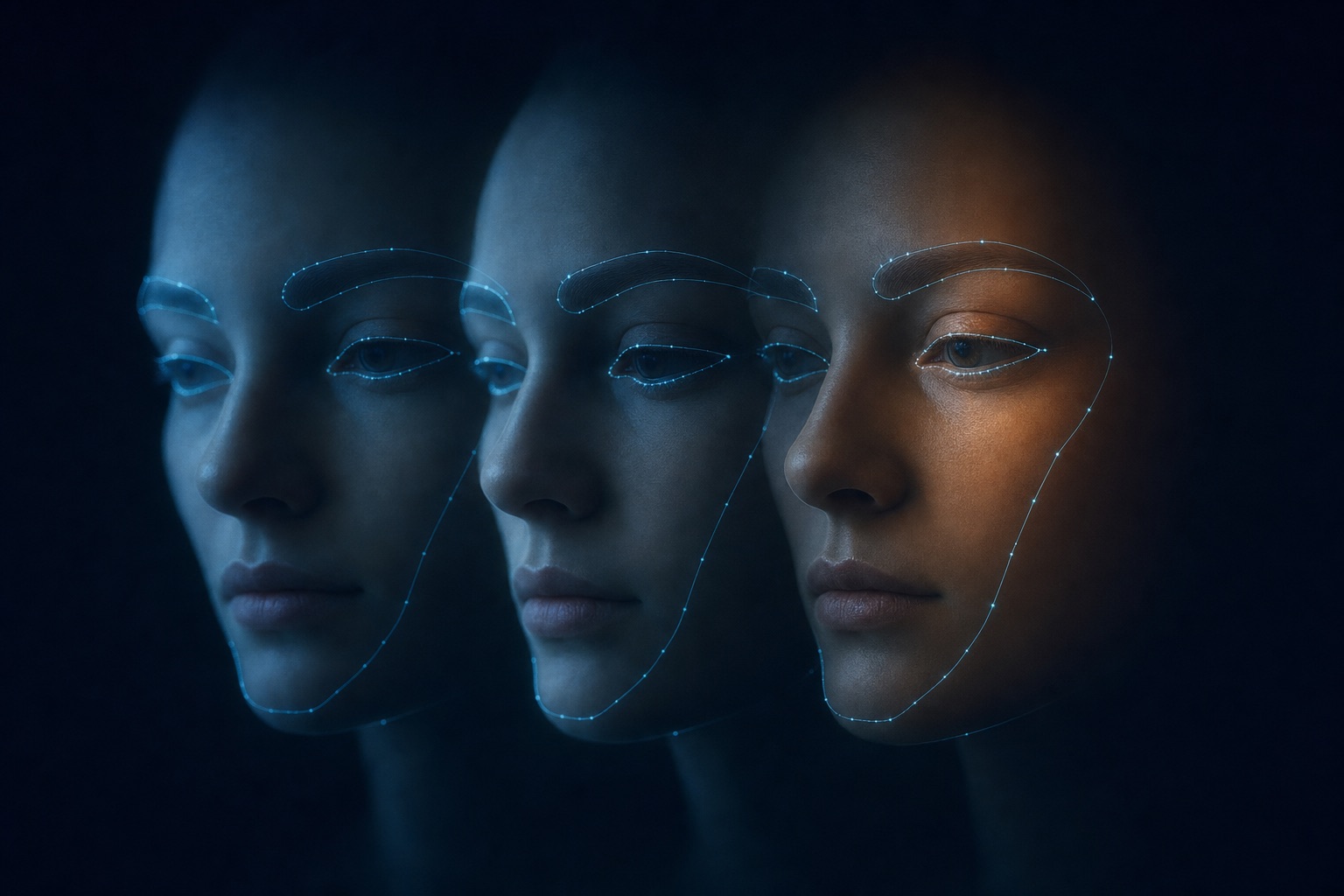
Three sampled moments from fifteen seconds of silence. Blink rate, breathing and micro-head-movement are where render quality is hardest to fake. Image generated with GPT Image 2.
2. The clock test
Record both sides of the interaction on one clock — your microphone input and the rendered output, captured together. Do not use the vendor's reported timings. Measure from the end of your speech to the first audible word of the reply, across at least 30 turns, and report p50 and p95 separately. Expect the p95 to be considerably worse than the demo, and expect that to be the number your users experience.
3. The join test
Cold-start a session twenty times and measure the wall-clock time from initiation to first rendered frame. Nobody publishes this and it dominates first impressions in walk-up settings.
4. The barge-in test
Interrupt at the start, middle and end of the avatar's sentence. Separately, test a backchannel ("mm-hm"), a genuine correction ("no, Friday"), and pure background noise. Check three things: does it stop when it should, does it not stop when it shouldn't, and does it resume with context intact.
5. The bandwidth test
Throttle to 1.5 Mbps, then 500 ms of added jitter, then 500 kbps. This is where the providers separate most dramatically, and it is invisible on an office connection. Independent testing found several providers that look excellent on fibre freeze or disconnect under constrained bandwidth — which is exactly what a conference wifi network is.
6. The blind test
Put two or three candidates in front of ten people who do not know which is which, and ask them to rank the experience rather than the appearance. Given that responsiveness predicts satisfaction more strongly than visual quality, do not be surprised when the prettiest model loses.
How to Choose
Compressed to the decisions that actually branch:
- You already have a working voice agent. Buy an Audio-to-Video API, not an Agent API. Beyond Presence, Simli and HeyGen all sell the render layer alone, and you keep control of the thing that determines whether the conversation is any good.
- You need the highest visual and expressive quality. Anam's Cara-4 and Tavus's Phoenix-4 lead independent assessments, at the top of the price range. Budget for concurrency, not just minutes.
- You need high volume at low cost. Simli, at a genuine order of magnitude below the field — provided you have validated the idle state against your actual session pattern.
- You need offline, air-gapped, or all-day installation economics. bitHuman's local model, or NVIDIA ACE with Audio2Face-3D if you can carry the 3D pipeline.
- You need a stylised or non-human character. LemonSlice for generated styles; Uneeq or NVIDIA ACE for authored 3D.
- You need it embedded in a product this week. An Agent API with a widget. Accept the ceiling, and plan the migration to a render layer for when the conversation quality becomes the binding constraint.
The Bottom Line
The models in this category are converging faster than the marketing around them. Independent reviewers evaluating ten providers side by side concluded that quality differences between them are real but not large, that the technology is ready for training, recruitment and sales use cases, and that costs span a 35× range that is changing rapidly.
What is not converging is measurement. Until somebody publishes a shared benchmark that all vendors run — end-to-end conversational latency, p50 and p95, from recorded audio, under realistic bandwidth — the only number you can trust is the one you measured yourself.
Spend the day. Run the six tests. The results will not match the spec sheets, and the gap is the whole point.