


- AI tools
- Artificial Intelligence
GPT Live 1 API Is Here: Pricing, Features, and How It Works
GPT Live 1 brings full-duplex voice conversations to the OpenAI API. Learn how it works, what $0.05 per minute includes, and how it compares with GPT-Realtime-2.1.

OpenAI has brought ChatGPT-style full-duplex conversation to developers. The important change is not just a new voice—it is a new division of labor between the conversation and the work happening behind it.
Voice assistants have improved quickly, yet many still reveal their machinery. They wait too eagerly during a pause, keep talking after you interrupt, or go quiet while a tool looks up an order. OpenAI’s GPT-Live 1 API launch is an attempt to make that machinery less visible.
Released on September 10, 2026, GPT-Live 1 can listen and speak at the same time. It handles the rhythm of the conversation itself, while a separate backend model or agent can reason, search, call approved tools, and return a result. That architecture is the central idea to understand before comparing prices or benchmarks.
This guide covers what GPT Live 1 is, what its $0.05-per-minute price includes, how delegation works, and how it differs from GPT-Realtime-2.1 and traditional speech pipelines. We use “GPT Live 1” where people are likely to search for it; OpenAI styles the product name GPT-Live 1, and the exact API model ID is gpt-live-1.
Quick answer — checked September 11, 2026
GPT-Live 1 is available in the OpenAI API now. The full-duplex voice frontend costs $0.05 per session minute, billed per second. Backend model usage, tools, telephony, and your application infrastructure are separate costs. It supports text and audio input/output, streaming, and delegated tool use; image and video are not supported by the Live frontend.
| GPT Live 1 fact | Confirmed detail |
|---|---|
| Release date | September 10, 2026 |
| API model ID | gpt-live-1 |
| Price | $0.05 per voice-session minute, billed per second |
| Extra charges | Backend model, tools, telephony, storage, and application infrastructure |
| Inputs → outputs | Text and audio → text and audio |
| Connections | WebRTC, WebSockets, sideband server control, and telephony/SIP paths |
| Knowledge cutoff | July 31, 2025 |
| Free API tier | Not supported |
What is GPT Live 1?
GPT-Live 1 is a real-time voice model built to manage the conversational layer of an application. It receives a continuous audio stream, produces speech, and reasons over incoming and outgoing audio together. In plain English, it does not have to stop listening simply because it has started talking.
That makes the model well suited to the messy parts of real speech: “mm-hm” acknowledgements, hesitations, laughter, background conversation, corrections halfway through a sentence, and interruptions that change what the speaker actually wants.
GPT-Live 1 is not meant to carry every difficult business workflow inside the voice model. For deeper reasoning and tool use, it delegates to a backend selected by the developer. OpenAI gives examples such as using a smaller model like Luna for high-volume scheduling or order updates and a model like Astra for complex customer issues. With client delegation, the backend does not need to be an OpenAI model at all.
For the exact API facts, current access links, and provider sources, see the new GPT-Live 1 model page in Cody’s model library.
Why full-duplex voice feels different
Most people do not speak in neat alternating blocks. We pause to think without giving up the floor. We say “right” while someone else is talking to show we are following. We start a correction before the other person finishes. A turn-based system has to guess whether each silence or sound means “respond now,” “keep listening,” or “stop speaking.”
Full duplex means the system can listen while it speaks. That does not guarantee a natural conversation by itself, but it gives the model the acoustic context needed to react to overlap as it happens. A short acknowledgment can be treated differently from a genuine interruption. A thoughtful pause can remain a pause instead of becoming an invitation for the assistant to jump in.
This is also why a simple “time to first audio” number cannot describe the whole experience. A voice agent can start speaking quickly and still feel rude if it interrupts a user who is thinking. It can have good speech quality and still feel slow if it becomes silent every time a backend tool runs. Turn timing, recovery, background-noise behavior, and task completion all matter together.
How GPT Live 1 delegation works
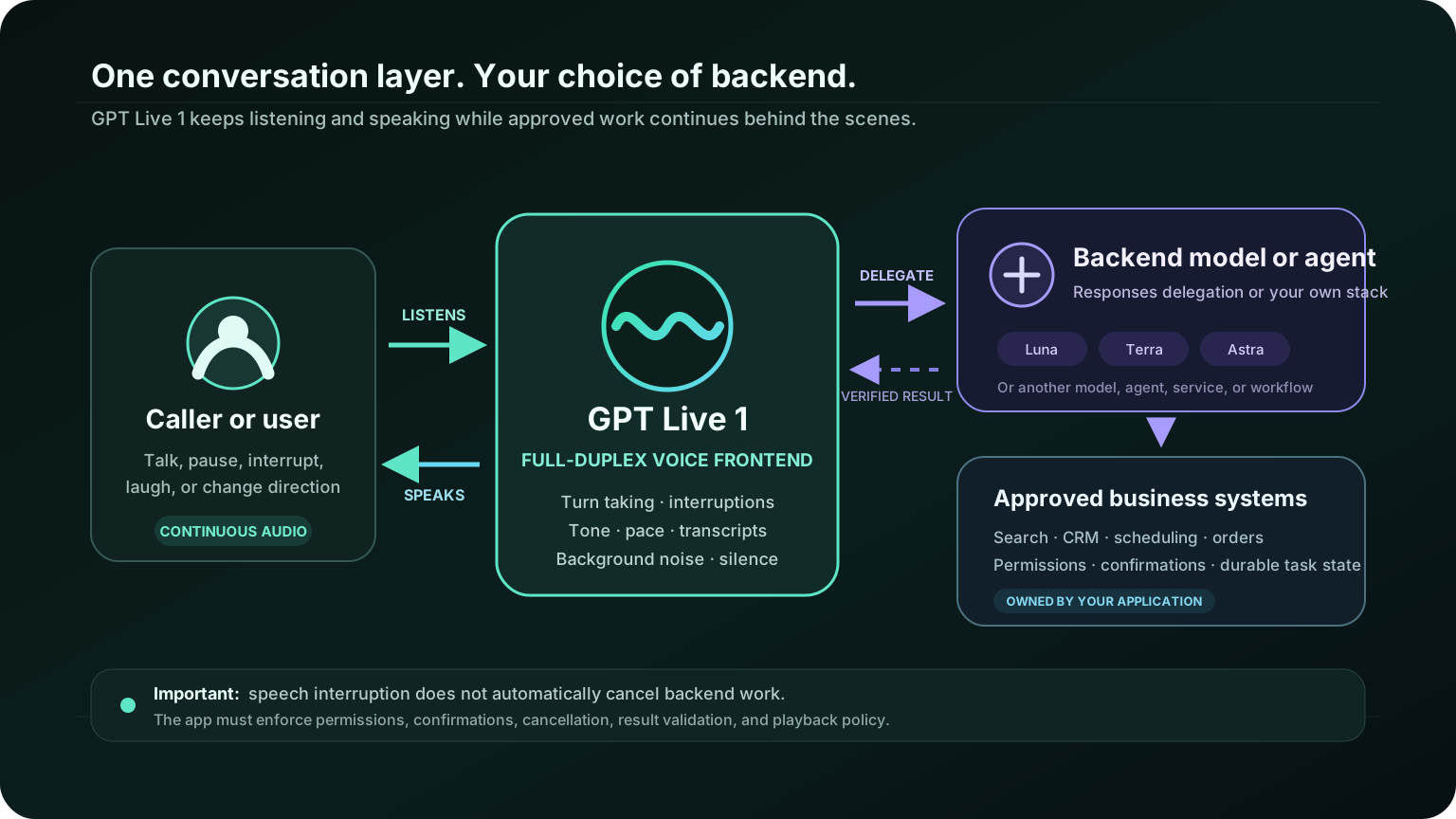
Delegation separates the voice frontend from the backend agent. GPT-Live 1 can keep the conversation moving—acknowledging the request or asking a useful follow-up—while deeper work runs elsewhere. OpenAI documents two ways to connect that work.
Responses delegation
With Responses delegation, GPT-Live 1 prepares the backend request, sends relevant conversation context to the OpenAI Responses model chosen for the session, and brings the result back into the spoken conversation. It is the more managed route and the easier place to start when one Responses model and its supported tools fit the job.
The backend choice is independent of the voice model. A team can route routine work to a faster or less expensive model and reserve heavier reasoning for cases that justify it. This also means the quality and total cost of a GPT-Live 1 agent depend partly on the backend configuration—not only on the voice frontend.
Client delegation
With client delegation, the application receives a delegation event, assembles the appropriate transcript and business context, calls any model, agent, service, or custom workflow, then decides what result to send back. This route adds engineering work but provides much more control.
Client delegation is the better fit when results must be validated or redacted before they are spoken, several backends need custom routing, private systems must stay inside an existing agent harness, or a team needs its own budgets, checkpoints, and fallback logic.
In both modes, the application—not GPT-Live 1—remains responsible for permissions, confirmations, business records, and durable task state. Delegation is a communication mechanism, not an authorization system.
GPT Live 1 features that matter
- Simultaneous listening and speaking: the model reasons over incoming and outgoing audio together instead of treating each as an isolated turn.
- Natural interruption handling: it can respond differently to a backchannel, a correction, or a genuine attempt to take the floor.
- Delegated reasoning and tools: deeper work can run through a selected Responses model or an application-operated backend.
- Prompted voice behavior: developers can shape tone, pace, style, backchannels, interruption behavior, and when the model should delegate.
- Native transcripts: ASR transcripts and response text are available alongside the audio stream.
- Alphanumeric and keyword support: OpenAI highlights stronger handling of names, codes, and other exact strings, plus keyword biasing.
- Silence and background-noise handling: the model is designed to avoid treating every sound or pause as a command to respond.
- Long-session reliability: OpenAI says it improved context retention and conversation quality across longer interactions.
- Browser, server, and phone connections: the documented paths include WebRTC, WebSockets, sideband control, and telephony/SIP.
The model page also lists streaming and function calling as supported. Structured outputs, fine-tuning, and predicted outputs are not supported for GPT-Live 1.
GPT Live 1 pricing
The headline rate is simple: $0.05 per minute for the front-end voice session. OpenAI bills by the second, so a 61-second session is not rounded up to two full minutes.
What a voice session costs
| Voice usage | GPT-Live 1 frontend cost |
|---|---|
| 10 minutes | $0.50 |
| 30 minutes | $1.50 |
| 100 hours (6,000 minutes) | $300 |
| 1,000 hours (60,000 minutes) | $3,000 |
These examples are simple list-price multiplication. They are useful for estimating the conversation layer, but they are not the total cost of operating a voice agent.
The costs not included in $0.05 per minute
- The backend model that performs reasoning or generates delegated results.
- Paid tools such as web search or other provider services.
- Telephony carrier, phone number, SIP, or partner-platform charges.
- Your servers, storage, monitoring, observability, and audio infrastructure.
- Human escalation, quality review, and support operations.
A realistic forecast is therefore: voice-session minutes + backend usage + tools + phone/transport + application costs. Capture those pieces separately during a pilot. Cost per completed task is often more useful than cost per minute because a more natural call may resolve faster—or may encourage a longer conversation.
OpenAI’s model page measures rate limits in concurrent sessions. It currently lists 25 sessions for Tier 1, 50 for Tier 2, 200 for Tier 3, 300 for Tier 4, and 500 for Tier 5. Production teams should confirm current limits and request capacity before a large launch.
GPT Live 1 vs GPT-Realtime-2.1
Both are OpenAI voice models, but they solve the architecture differently. GPT-Realtime-2.1 is a speech-to-speech reasoning model that can receive text, image, and audio context and call functions inside a realtime session. GPT-Live 1 is a dedicated full-duplex conversation frontend that delegates deeper reasoning and actions to a separate backend.
| Question | GPT-Live 1 | GPT-Realtime-2.1 |
|---|---|---|
| Core design | Full-duplex voice frontend plus delegated backend | Realtime speech-to-speech model with reasoning and function calling in the session |
| Published billing | $0.05 per session minute, plus backend usage | Token based: audio, text, and image rates vary by input/output class |
| Voice behavior | Designed around simultaneous listening and speaking | Realtime dialogue with turn detection and interruption handling |
| Frontend input | Text and audio | Text, image, and audio |
| Backend flexibility | Responses model or any client-operated model, agent, or service | One configured realtime model and its available tools |
| Best reason to test | More natural overlap plus independent backend routing | A unified multimodal realtime session with token-based usage |
The price rows cannot be converted into a fair universal “cheaper model” verdict. GPT-Live 1 charges for elapsed session time and adds a backend bill. GPT-Realtime-2.1 charges tokens across several media classes. Silence, speaking ratio, response length, image use, tools, caching, and backend choice all change the result.
Use Cody’s model library to inspect the current GPT-Live 1 vs GPT-Realtime-2.1 comparison or compare GPT-Live 1 with the other models in the voice and realtime category.
GPT Live 1 vs a traditional STT-LLM-TTS pipeline
A traditional voice agent usually connects three systems: speech-to-text, a language model, and text-to-speech. That modularity is valuable. Teams can choose the best transcription model for a language, validate a complete text response before speech begins, and replace one component without replacing everything.
The tradeoff is orchestration. Every handoff creates another queue, another format conversion, and another place where timing or context can be lost. The application must decide when an utterance ends, what to do if the caller interrupts the synthesized speech, and how the transcript should change after a self-correction.
GPT-Live 1 collapses the listening and speaking stages into one continuous voice layer while preserving a separate backend for deeper work. That can simplify turn-taking and reduce the “walkie-talkie” feeling, but it does not eliminate the need for an application layer. The app still has to manage actions, privacy, failure recovery, telephony, and the source of truth for the task.
Choose based on the hardest requirement. If complete pre-speech validation and component-level control are mandatory, a cascaded pipeline may remain attractive. If conversation flow, overlap, and continuing to engage while a task runs are central, GPT-Live 1 is a compelling architecture to test.
What OpenAI's benchmarks do and do not prove
OpenAI reports that GPT-Live 1 improved its Full Duplex Bench result by 30 percentage points over GPT-Realtime-2.1, with gains in turn-taking latency and interactive behavior. Paired with GPT-6 Astra at medium reasoning effort, OpenAI also reports a number-one Tau3 result for end-to-end voice-agent tasks.
In an early customer evaluation, language-learning company Speak reported almost 80% fewer interruptions during learner thinking pauses than its previous turn-based systems. OpenAI also published favorable customer accounts from Yelp, Fin, Cognition, and others.
Those results are useful signals, but they remain provider-published evaluations and customer reports. The Astra result measures a combined system, not GPT-Live 1 alone. None of the numbers guarantees performance on your phone carrier, accents, noise, tool latency, prompt, or business workflow. We have not reproduced them as a Cody benchmark.
A strong evaluation should score at least: completed tasks, inappropriate interruptions, recovery after corrections, end-of-turn timing, tool accuracy, latency percentiles, escalation quality, cost per completed task, and human preference across representative calls.
GPT Live 1 voices and language support
OpenAI’s launch lists twelve voices: Quartz, Ripple, Vesper, Willow, Stone, Gleam, Meridian, Bossa, Tempo, Beacon, Delta, and Cinder. The company says the selection expands coverage across accents, dialects, and languages and plans to add more over time.
OpenAI does not publish one exact language list on the GPT-Live 1 model page. “Broader language availability” should therefore not be read as a guarantee for every locale, accent, or code-switching pattern. Test real speakers, background conditions, names, addresses, confirmation phrases, and the languages your product promises to support.
Custom voice access is not a self-serve default. OpenAI directs interested organizations to contact sales for eligibility and the request process.
How to connect GPT Live 1
OpenAI documents several connection patterns. The right one depends on where audio originates and which system needs control of the session.
WebRTC for browser voice apps
WebRTC is the recommended starting point for browser-based voice applications. Media tracks carry the microphone and speaker audio, while a data channel carries session events. A trusted server should create the session and keep the OpenAI API key out of the browser.
WebSockets for server-side audio
WebSockets fit server-side integrations where the application owns the audio stream. The main socket carries audio and control events. If the browser owns the WebRTC connection but the server still needs transcripts, monitoring, or corrective instructions, a sideband WebSocket can attach server controls without moving audio away from WebRTC.
Telephony and SIP for phone agents
OpenAI documents telephony and SIP integration paths and provides partner guidance for systems such as LiveKit, Twilio, Telnyx, Daily, and Pipecat. Carrier and partner fees remain separate from the GPT-Live 1 session charge.
A practical GPT Live 1 setup plan
- Choose one narrow call. Start with a bounded workflow such as checking an order, qualifying a lead, or finding an appointment—not an all-purpose agent.
- Choose the connection. Use WebRTC for a browser prototype, WebSockets when a server owns the audio, or a documented telephony route for phone calls.
- Keep the live prompt short. Put tone, pace, interruption style, backchannels, and delegation policy in the voice prompt. Keep detailed business workflows and tool rules in the backend.
- Select delegation. Start with Responses delegation for a managed OpenAI backend. Use client delegation when you need custom context, validation, routing, or a non-OpenAI service.
- Enforce action rules in code. Check identity, authorization, confirmations, budgets, and allowed state changes before a tool runs.
- Preserve transcripts and task state. Transcript deltas can be incomplete or wrong. Store enough history to understand “yes,” “Friday instead,” and corrections that refer to earlier details.
- Test messy audio. Include slow thinkers, interruptions, side conversations, noise, spelling, account numbers, silence, disconnections, and escalation to a human.
- Measure the complete system. Track both conversation quality and backend task success, plus every cost that sits outside the voice-minute rate.
Migrating from Realtime or a cascaded voice stack
Migration is not simply changing the model ID. The most important change is to split responsibilities intentionally.
- Move conversational style to the Live prompt. Define how the voice should speak, wait, acknowledge, interrupt, and delegate.
- Keep detailed workflows in the backend. Business rules, tool schemas, validation, permissions, and long outputs belong with the agent doing the work.
- Adapt to continuous audio events. GPT-Live 1 streams audio continuously and has different session events from the Realtime API; do not assume the same manual commit-and-trigger flow.
- Translate function calls into delegation. The Live frontend asks a backend for help rather than issuing ordinary structured tool arguments in the same way as a text or realtime agent.
- Keep existing safeguards. Retain monitoring, action blocks, confirmations, audit records, cancellation, and escalation. Adapt them for a model that may continue speaking while checks run.
Run the old and new architecture against the same recorded scenarios where policy allows. Compare full-call outcomes, not a polished demo. Our separate guide to voice-agent latency explains why transport, transcription, reasoning, tools, and playback must be measured together.
Production caveats worth understanding
Your application still owns the risky decisions
GPT-Live 1 can make a conversation sound confident; that does not prove an external action was authorized or completed. Check permissions and required confirmations before changing an appointment, charging a card, exposing an account record, or announcing success. Persist the source-of-truth task state outside the voice session.
An interruption is not a cancellation
If a caller says “Actually, Friday instead” while a Thursday lookup is running, interrupting the speech does not cancel that lookup. The application must revise the active task, invalidate outdated confirmations, cancel work where possible, and prevent a late Thursday result from being spoken as current.
Continuous speech changes the guardrail design
A text agent can finish and validate an entire answer before showing it. GPT-Live 1 may speak while backend work or policy checks continue. Withholding a tool result does not guarantee that the voice frontend stays silent. Monitor both transcripts and actions, block unsafe tools in application code, and control playback where pre-speech approval is required.
Some decisions still need the original audio
A delegated backend does not automatically receive the raw waveform. If a workflow depends on acoustic evidence—a voicemail beep, speaker cadence, a second person joining, or another non-text signal—route the original audio to an appropriate detector or reviewer. Do not assume a transcript contains every signal the frontend heard.
Who should test GPT Live 1?
GPT-Live 1 is most interesting for products where conversational timing is part of the job: customer support, appointment scheduling, restaurant reservations, language tutoring, sales qualification, accessibility, hands-free work, and collaborative voice interfaces.
It is less obviously necessary for one-way narration, file transcription, simple text-to-speech, or workflows that must validate every complete sentence before any audio can play. Specialist speech services or a cascaded stack may offer more direct control for those cases.
The practical decision is not “Is GPT-Live 1 the best voice model?” It is: Does full-duplex conversation plus a separately chosen backend improve task success enough to justify the architecture and total cost? A representative pilot can answer that; a benchmark headline cannot.
Frequently asked questions
What is GPT Live 1?
GPT-Live 1 is OpenAI’s full-duplex voice model for real-time conversations. It listens and speaks at the same time, then delegates deeper reasoning and tool work to a separate backend agent.
How much does GPT Live 1 cost?
The front-end voice session costs $0.05 per minute and is billed per second. Backend model usage, tools, telephony, storage, and application infrastructure cost extra.
Is GPT Live 1 available now?
Yes. OpenAI released GPT-Live 1 in the API on September 10, 2026. Its exact API model ID is gpt-live-1. OpenAI’s model page says the Free API tier is not supported.
What is full-duplex voice AI?
Full duplex means the voice system can listen while it is speaking. That makes overlapping speech, acknowledgements, interruptions, and natural pauses easier to handle than a rigid one-speaker-at-a-time exchange.
What is the difference between GPT Live 1 and GPT-Realtime-2.1?
GPT-Live 1 is a minute-billed full-duplex voice frontend that delegates deeper work to a backend model. GPT-Realtime-2.1 is a token-billed speech-to-speech model that handles audio, reasoning, and function calling within its realtime session.
Can GPT Live 1 call tools?
Yes, through delegation. Responses delegation uses a selected OpenAI Responses model. Client delegation lets the application call another model, agent, service, or custom workflow and decide which verified result comes back.
Does interrupting GPT Live 1 cancel a backend task?
No. Interrupting speech does not automatically cancel backend work. The application must decide whether to cancel, revise, or discard an outdated result.
Does GPT Live 1 support WebRTC, WebSockets, and phone calls?
Yes. OpenAI documents WebRTC for browser voice apps, WebSockets for server-side audio, sideband server controls, and telephony or SIP integration paths.
Which voices are available for GPT Live 1?
OpenAI’s launch lists Quartz, Ripple, Vesper, Willow, Stone, Gleam, Meridian, Bossa, Tempo, Beacon, Delta, and Cinder. Custom voice access requires an eligibility and sales process.
Sources and methodology
This article was checked against first-party OpenAI material on September 11, 2026. Benchmark and customer results are labeled as OpenAI-reported rather than presented as independent Cody measurements.
- OpenAI: GPT-Live 1 API launch announcement
- OpenAI: GPT-Live 1 model page, price, features, and rate limits
- OpenAI: getting started with GPT-Live
- OpenAI: GPT-Live prompting guide
- OpenAI: GPT-Live delegation and tools
- OpenAI: migration guidance for GPT-Live
- OpenAI: API pricing
The bottom line
GPT-Live 1 is more than a new synthetic voice. It changes the shape of a voice agent: one full-duplex model manages the human rhythm of the conversation, while a separately chosen backend handles the harder work.
The $0.05-per-minute price makes the frontend easy to estimate, but the backend, tools, phone network, and application still determine the total bill and much of the task quality. The most useful next step is a narrow pilot with realistic interruptions, corrections, noise, and permissions—not a clean scripted demo.
Explore the GPT-Live 1 model guide, compare it directly with GPT-Realtime-2.1, or browse the full voice AI model directory.