

- AI tools
- Artificial Intelligence
MiniMax H3 Max: Price, Speed, and How It Compares
H3 Max pairs unusually fast AI video generation with native audio and strong image-to-video results. Here is what the claims, costs, limits, and comparisons really mean.

H3 Max is being described as a breakthrough AI video model because a five-second clip can reportedly render in less time than it takes to watch. The more useful story is what that speed lets creators do—and where the model still asks for compromise.
The AI video market has trained us to wait. A creator writes a prompt, watches a progress indicator, studies the result, changes three words, and waits again. fal introduced H3 Max on August 27, 2026 with a different pitch: five seconds of 768p video in roughly three seconds, with synchronized audio and competitive visual quality.
That claim deserves attention, but it also needs context. H3 Max is a fal post-trained version of MiniMax H3, not simply a new MiniMax product tier. The eye-catching speed number comes from fal's own infrastructure test. And while fal reported a first-place result in its internal preference study, the current independent picture is more nuanced.
As of our September 14 check, H3 Max ranked first for image-to-video with audio and third for text-to-video with audio in the Artificial Analysis Video Arena. That combination—top-tier preference results, native audio, useful reference controls, and unusually fast iteration—is the real reason people are talking about it.
This guide explains what H3 Max is, how much it costs after the launch promotion, what the speed numbers measure, and how it compares with other leading video generators. For the compact specs, API routes, sources, and live cost calculator, open the MiniMax H3 Max model page.
Quick answer — checked September 14, 2026
H3 Max is a hosted fal video model built by post-training MiniMax H3. It creates 5–15 second clips with audio from text, keyframes, or multimodal references. Native output is 768p, with a 1080p latent-refinement option. Standard pricing begins at $0.05 per generated second for 480p, $0.08 for 768p, and $0.16 for 1080p. fal measured about 2.46 seconds of backend inference for one five-second 768p clip; real wait time also includes queueing, prompt expansion, encoding, and download.
| H3 Max fact | Current detail |
|---|---|
| Released | August 27, 2026 |
| Developer | fal, built from MiniMax H3 |
| Video length | 5–15 seconds |
| Resolution | 480p, native 768p, or 1080p latent refinement |
| Audio | Generated with the video |
| Input routes | Text, first/end image, or image/video/audio references |
| Standard price | $0.05–$0.16 per generated second, depending on resolution |
| Headline speed | fal test: about 2.46 seconds of inference for a 5-second 768p clip |
| Current arena position | #1 image-to-video with audio; #3 text-to-video with audio at our September 14 check |
What is MiniMax H3 Max?
H3 Max is a video-generation model developed by fal on top of the open-weight MiniMax H3 foundation. fal says it added post-training data focused on prompt adherence and visual aesthetics, then co-designed the inference stack so the tuned model could run efficiently on its platform.
That history matters because three related things can easily be confused:
- MiniMax H3 is the underlying omni-modal video system created by MiniMax.
- H3-Base is the part MiniMax released with downloadable weights and separate checkpoints for first/last-frame and reference-guided generation.
- H3 Max is fal's post-trained, hosted edition. fal has not published a downloadable H3 Max weight release in the official materials reviewed for this article.
MiniMax describes the complete H3 system as a pipeline with H3-Context-IR for preparing the instruction, H3-Base for generating native 768p video and audio, and H3-Regenerate-2K for a high-resolution regeneration pass. The open-source repository currently makes H3-Base available, while the context and 2K modules remain hosted services.
H3 Max follows a different product path. It is served through fal's web interface and API, offers 1080p through latent refinement, and emphasizes speed. Saying that it is “based on open weights” is accurate. Saying that H3 Max itself is open source or natively generates 2K would not be.
Why is H3 Max getting so much attention?
There are many competent video models. H3 Max stands out because it combines three benefits that are usually traded against one another.
1. The feedback loop is unusually short
fal's September 8 timing shows about 2.46 seconds of backend inference for a five-second 768p H3 Max clip. It lists about 1.54 seconds for H3 Max Turbo and 15.17 seconds for a fifteen-second H3 Max clip at 768p. The company describes the standard five-second experience as under three seconds end to end on its optimized path.
Even if a real application takes longer, moving from minutes to seconds changes the creative process. Teams can explore camera motion, wording, pacing, framing, and sound as a rapid loop instead of treating each generation as a small production decision. A model does not have to win every quality category to be valuable if it lets a director test ten plausible directions before another system returns one.
2. Its strongest independent result is genuinely strong
fal says H3 Max placed first overall, for prompt understanding, and for aesthetics in its own human preference evaluation against twelve models. That is useful evidence, but it is still a provider evaluating its own release.
The independent Artificial Analysis image-to-video arena provides a stronger reason for the excitement. At our September 14 check, H3 Max was first in the image-to-video-with-audio category, ahead of Seedance 2.0 720p and base MiniMax H3. In the text-to-video-with-audio arena, it was third behind Wan 3.0 and Gemini Omni Flash.
So the honest headline is not “H3 Max is the best video model.” It is that H3 Max currently leads one important audio-enabled arena, sits near the top of another, and reaches those results through an endpoint optimized for unusually fast iteration.
3. It is more than a text-to-video demo
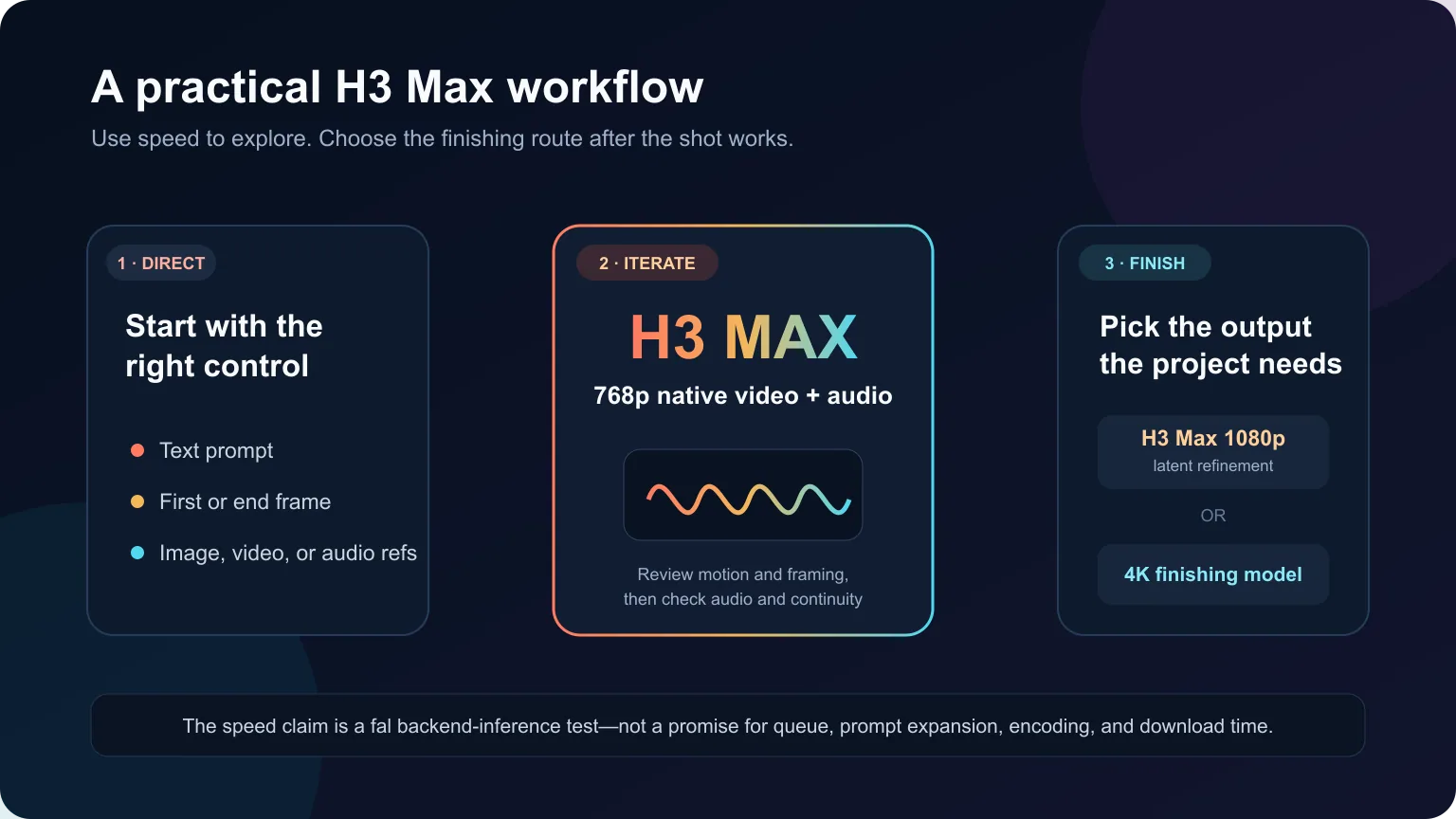
H3 Max generates synchronized sound with the picture and exposes three practical routes. Text-to-video starts from a prompt. Image-to-video can use a first image, an end image, or both as keyframes. Reference-to-video accepts image, video, and audio material to guide identity, appearance, motion, style, or sound.
That range matters in production. Text is excellent for exploring an idea, but a supplied frame gives art direction more control. References can help a sequence preserve a subject or aesthetic. Native audio can remove a separate sound-generation step when the first goal is a complete concept rather than a silent visual test.
H3 Max pricing
fal prices H3 Max by the length and resolution of the generated clip. The durable rates below take effect September 15, 2026.
| Resolution | Standard price per second | 5-second clip | 15-second clip |
|---|---|---|---|
| 480p | $0.05 | $0.25 | $0.75 |
| 768p | $0.08 | $0.40 | $1.20 |
| 1080p | $0.16 | $0.80 | $2.40 |
A 75% launch promotion runs through September 14. During that promotion, the same rates are $0.0125, $0.02, and $0.04 per second. This is why some posts quote a ten-cent five-second 768p clip. That number is real for the promotion, but the standard cost for the same clip is forty cents.
H3 Max Turbo is half the standard model's rate: $0.025 per second at 480p, $0.04 at 768p, and $0.08 at 1080p after the promotion. It is the more aggressive speed-and-cost option, while the regular H3 Max is the better reference point for quality comparisons. fal also offers five free generations a day to signed-in users in its web experience, which is enough to test a few real prompts before setting up an API workflow.
Reference-to-video has a second cost
The reference route charges for the output video at the normal H3 Max rate and can also charge for reference-input tokens. fal includes the first 4,096 reference tokens, then lists $0.02 per additional 1,000 tokens. A 1024 × 1024 image is roughly 1,000 tokens, so several still images may fit inside the allowance. Video references can consume far more.
fal's example estimates a five-second video reference at 37,296 tokens for a 768p output. After the included allowance, that is about $0.66 in reference processing before the generated clip itself. The lesson is simple: H3 Max is inexpensive for prompt and keyframe iteration, but reference-heavy jobs need their own estimate.
How fast is H3 Max, really?
The popular answer is “about three seconds for a five-second clip.” The precise answer is that fal measured about 2.46 seconds of backend inference for one five-second 768p configuration on its own optimized stack.
An end user experiences more than inference. A request can include queue time, prompt expansion, input download, model execution, encoding, output upload, and the application's own network path. fal says balanced prompt expansion adds around a second; the quality expansion option can add as much as roughly thirty seconds. Longer clips and the 1080p refinement path also take more work.
That does not make the speed claim meaningless. It makes it a controlled measurement rather than a service-level promise. A useful evaluation should record both:
- backend or provider-reported inference time, which helps explain the model's underlying throughput; and
- click-to-download time in your account, including queueing and every option your product actually enables.
Test at busy and quiet periods, across all required durations and resolutions. Also measure the percentage of generations worth keeping. The fastest model can be expensive in practice if a team needs many retries, while a slower model may be economical if it lands the shot more often.
H3 Max benchmarks: what is confirmed and what is marketing?
Video leaderboards are valuable, but they are not a single world championship. A model can rank differently for text-to-video and image-to-video, and again depending on whether audio is evaluated. Prompt sets, output settings, sample counts, and the provider used for inference also affect the result.
Artificial Analysis uses blind pairwise preferences and an Elo-like score that is recalculated as new votes arrive. Its standard comparison settings aim for 1080p or the closest available resolution, ten-second clips, 16:9 framing, and 24 frames per second or the closest model option. The rankings can therefore move after publication.
| Claim | Status at our September 14 check | How to read it |
|---|---|---|
| H3 Max is #1 overall in fal's evaluation | Provider-reported | Useful launch evidence, but fal designed the model and the evaluation. |
| H3 Max is #1 for image-to-video with audio | Confirmed in the current Artificial Analysis arena | Its clearest independent quality signal today. |
| H3 Max is #1 for text-to-video with audio | Not current | It ranked third, behind Wan 3.0 and Gemini Omni Flash, when checked. |
| A five-second 768p clip takes about 2.46 seconds | fal measurement | Backend inference on fal's stack, not a universal end-to-end SLA. |
The safest way to use a leaderboard is to build a shortlist, not crown a permanent winner. Run the same prompts and source images through the models you can actually buy, at the resolutions and durations you need, and have reviewers compare the results without seeing the model names.
H3 Max vs other leading AI video models
The comparison below uses current provider-published rates at roughly the 720p–768p tier with audio wherever possible. It is not perfectly uniform: Seedance uses a token formula, Kling charges separately for audio, and Veo's allowed durations depend on resolution. That is why the model name and the exact endpoint both matter.
| Model | Comparable price | Length | Resolution | Speed evidence | Best fit |
|---|---|---|---|---|---|
| MiniMax H3 Max | $0.08/s at 768p | 5–15s | 768p native; 1080p refinement | fal: ~2.46s inference for a 5s 768p clip | Fast iteration, image-to-video with audio, references |
| Veo 3.1 Fast | $0.10/s at 720p; $0.12/s at 1080p | 4, 6, or 8s | Up to 4K at 8s | Google: 11s–6min at peak | Higher-resolution Google workflows |
| Kling Video 3.0 Pro | $0.112/s silent; $0.168/s with audio on fal | Up to 15s | Endpoint dependent; separate 4K route | No universal time published | Multi-shot scenes, elements, optional audio controls |
| Seedance 2.5 | About $0.473/s at 720p on fal | 4–30s | 720p text route; image route also lists 1080p | No universal time published | Longer clips and reference-rich storytelling |
| LTX-2.5 Fast | $0.09/s at 720p; $0.13/s at 1080p | 6–20s | Up to 4K | No universal time published | Broader resolution range and audio-led input |
| Grok Imagine Video 1.5 | $0.14/s at 720p; $0.25/s at 1080p | 1–15s | Up to 1080p | xAI: typically up to several minutes | Straightforward xAI API and flexible short lengths |
These are list-price and specification comparisons, not a declaration that the least expensive row will produce the lowest-cost usable video. If a model needs four attempts for every accepted result, its effective creative cost is four times the sticker price before human review.
For a closer pairwise view, use our dedicated pages for H3 Max vs Veo 3.1 Fast, H3 Max vs Kling Video 3.0 Pro, H3 Max vs Seedance 2.5, H3 Max vs LTX-2.5 Fast, and H3 Max vs Grok Imagine Video 1.5. The broader AI video model directory lets you compare more options.
H3 Max vs Veo 3.1 Fast
Choose H3 Max when the speed of the idea-to-review loop matters most, a fifteen-second single generation is useful, or image-to-video with generated audio is central. Choose Veo 3.1 Fast when Google integration, a 4K option, or Veo-specific extension and reference workflows are more important. At the closest base tier, their standard prices are fairly close; the larger distinction is duration, resolution, and published latency.
H3 Max vs Kling Video 3.0 Pro
Both can create clips up to fifteen seconds and support reference-led work. H3 Max has the clearer published speed story and a lower 768p rate with audio. Kling's fal routes offer a broader set of element, motion-control, audio, and voice-control choices, but those options have different prices. Compare the exact Kling route rather than treating “Kling 3” as one configuration.
H3 Max vs Seedance 2.5
H3 Max is the simpler choice for rapid, inexpensive short-form iteration. Seedance 2.5 stretches to thirty seconds and is designed for richer reference-driven storytelling, but its token-based price is substantially higher for common 720p output. Use the source assets and shot length—not the leaderboard name—to decide which belongs in a test.
H3 Max vs LTX-2.5 Fast
LTX-2.5 Fast reaches 4K and accepts audio as a primary creative input, making it a stronger finishing candidate when resolution or audio-driven motion is essential. H3 Max is slightly less expensive at its native 768p tier and has a specific sub-realtime provider test. A practical workflow might test both at storyboard resolution before paying for a high-resolution final.
H3 Max vs Grok Imagine Video 1.5
Both cover short video with generated audio and output up to 1080p. H3 Max is less expensive at the comparable tier and currently has the stronger image-to-video arena position. Grok Imagine may fit teams already operating on xAI's API or projects that need lengths shorter than H3 Max's five-second minimum.
Understanding the 768p, 1080p, and 2K claims
Resolution is the easiest part of the H3 story to misstate. H3 Max is tuned around native 768p. fal's current endpoint also offers 480p and 1080p, but it describes 1080p as latent refinement from the native 768p source.
The 2K number belongs to the complete MiniMax H3 architecture, where H3-Regenerate-2K performs another generation stage. MiniMax has not released that module as open weights. fal's H3 Max pages direct users who need the base H3 2K workflow to the relevant H3 service rather than claiming H3 Max itself has the same 2K stage.
This does not automatically make H3 Max's 1080p output unsuitable. Social feeds, concept reviews, and many web placements do not need 4K. But teams producing broadcast masters, heavy crops, large displays, or detailed product footage should inspect the delivered pixels instead of assuming every “1080p” or “2K” label represents the same generation process.
Which H3 Max input mode should you use?
Text-to-video for exploration
Start with text when composition and story direction are still open. The route supports several common aspect ratios and prompt-expansion settings. Keep the first prompt visual and direct: describe the subject, action, camera, environment, light, pacing, and sound in the order a reviewer should notice them.
Image-to-video for art direction
Use a first frame when the subject, product, palette, or layout must start in a known place. Add an end frame when the destination matters as much as the opening. H3 Max treats those images as keyframes, which is more controllable than repeatedly asking text alone to rediscover the same composition.
Reference-to-video for continuity
Use references when a person, object, performance, motion, sound, or style should carry into the generated clip. fal's current guide allows a combined set of image, video, and audio references. Reference input is powerful but should not become a substitute for a clear shot brief—and its token charges should be included in the budget.
A practical way to test H3 Max
- Choose five representative shots. Include motion, a person or product, readable text if it matters, dialogue or sound, and one difficult continuity case.
- Begin at 768p and five seconds. That is the configuration closest to H3 Max's tuned path and the best place to understand its iteration advantage.
- Generate several blind variations. Save the prompt, route, seed where available, timing, and cost. Do not let reviewers see which model made which clip.
- Score usable outcomes. Review prompt adherence, motion, anatomy, temporal consistency, image identity, audio relevance, speech, text rendering, and editability.
- Move control up gradually. If text drifts, try a first frame. If identity still moves, test references. Track the extra input cost instead of treating every route as the same.
- Test the finishing requirement. Compare H3 Max's 1080p refinement with a higher-resolution model only on shots that survived creative review.
- Measure total time to an accepted clip. Include queueing, review, retries, upscaling, editing, and audio repair—not just the fastest API response.
This process may reveal that H3 Max should create the final asset. It may also reveal that its best role is upstream: quickly finding the composition, motion, or timing worth finishing elsewhere. Both outcomes are useful.
API access without the jargon
Developers use H3 Max through fal's queued API. There are three current endpoint families:
minimax/h3-max/text-to-videofor prompt-led generation;minimax/h3-max/image-to-videofor first- and end-frame control; andminimax/h3-max/reference-to-videofor image, video, and audio guidance.
A production application submits a request, receives a request identifier, watches the queue or webhook, and downloads the completed media. That asynchronous pattern is normal for video generation. Keep the model path with every job record because changing the endpoint can change the accepted inputs, price, and output behavior.
Privacy, storage, and rights
fal's API documentation says it stores request inputs and outputs by default. Developers can send the X-Fal-Store-IO: 0 header to prevent payload storage, and completed request data can be deleted. However, files uploaded separately to fal's CDN can remain accessible and require their own lifecycle handling.
That distinction matters for reference workflows. A no-store request is not the same as deleting every source image, audio sample, or video uploaded before the request. Sensitive projects should document how files enter the system, where each copy is stored, who can access it, and when it is deleted.
The fal model page marks H3 Max for commercial use, but a product label does not clear the rights in your inputs. Obtain permission for faces, voices, trademarks, artwork, music, and source footage. Review fal's current terms and any customer-specific agreement before using confidential or regulated media.
Who should try H3 Max?
H3 Max is especially worth testing for:
- creative teams producing many ad, social, storyboard, or pitch variations;
- image-to-video workflows that need synchronized audio;
- developers building interactive creation tools where waiting breaks the experience;
- reference-guided short clips that benefit from image, motion, or audio direction; and
- teams that want a low-cost 768p draft before deciding whether to pay for a higher-resolution finish.
It is less obvious as the only model for teams that require native 4K, long uninterrupted scenes, a downloadable H3 Max checkpoint, or a formal latency SLA. In those cases, use it as one candidate in a measured workflow rather than choosing it from the launch headline.
Frequently asked questions
What is H3 Max?
H3 Max is fal's post-trained, hosted version of MiniMax H3. It generates five- to fifteen-second video with audio from text, keyframes, or image, video, and audio references.
Who made H3 Max?
fal developed H3 Max using MiniMax H3 as the foundation. MiniMax created and released the underlying H3-Base weights; H3 Max is fal's tuned model and optimized inference service.
Is H3 Max open source?
Not as a published H3 Max weight release. It is built from MiniMax H3's open-weight base, but fal currently presents H3 Max as a hosted web and API model. MiniMax's open repository contains H3-Base checkpoints rather than fal's H3 Max post-training.
How much does H3 Max cost?
Standard fal pricing is $0.05 per generated second at 480p, $0.08 at 768p, and $0.16 at 1080p from September 15, 2026. A 75% launch promotion applies through September 14. Reference-to-video can add input-token charges.
How fast is H3 Max?
fal reports about 2.46 seconds of backend inference for a five-second 768p clip in its September 8 test. Queueing, prompt expansion, encoding, transfer time, resolution, and clip length affect the wait a user experiences.
Does H3 Max generate audio?
Yes. H3 Max generates synchronized audio with the video. Reference-to-video can also use audio as guidance.
What is the maximum H3 Max resolution?
The current fal endpoint offers up to 1080p through latent refinement from its native 768p path. The separate 2K regeneration stage discussed for the full MiniMax H3 system is not the same as H3 Max's current 1080p option.
Is H3 Max better than Veo 3.1 Fast?
Neither is universally better. H3 Max offers longer single clips, a lower comparable base rate, and a striking provider-reported speed result. Veo 3.1 Fast offers a 4K option and fits Google's video stack. Compare them on the exact shot type and delivery format you need.
Can I try H3 Max for free?
fal currently advertises five free web generations per day for signed-in users. API usage and limits follow the account's credits and current pricing.
Sources and methodology
This article was researched on September 14, 2026. Product construction, pricing, timing, and endpoint details come from fal's launch announcement, current H3 Max page, and the official text, image, and reference endpoints. Base-model architecture and open-weight scope come from MiniMax's H3 release and repository.
Current preference positions come from Artificial Analysis and should be treated as a dated snapshot because its scores update with new blind votes. We used its published methodology to distinguish arena results from fal's provider-run evaluation. Competitor prices and limits are linked through Cody's sourced model pages. Provider claims are labeled as such; calculations use published list prices and exclude tax, retries, storage, editing, and negotiated discounts.
The bottom line
H3 Max is not exciting merely because a benchmark says it is good. Its appeal comes from joining credible video and audio quality with a feedback loop fast enough to change how people create.
The caveats are equally clear. The famous speed figure is fal's backend test, 768p is the native path, 1080p is a refinement, and H3 Max is hosted even though it starts from an open-weight foundation. It currently leads image-to-video with audio in one respected arena, but it is third—not first—on the text-to-video-with-audio board we checked.
For fast concepting, image animation, and reference-guided short video, H3 Max belongs near the top of a 2026 test list. For 4K delivery, longer scenes, or strict deployment control, it belongs in a multi-model workflow. The right question is not whether H3 Max has won AI video. It is whether its speed helps your team reach an accepted shot sooner.